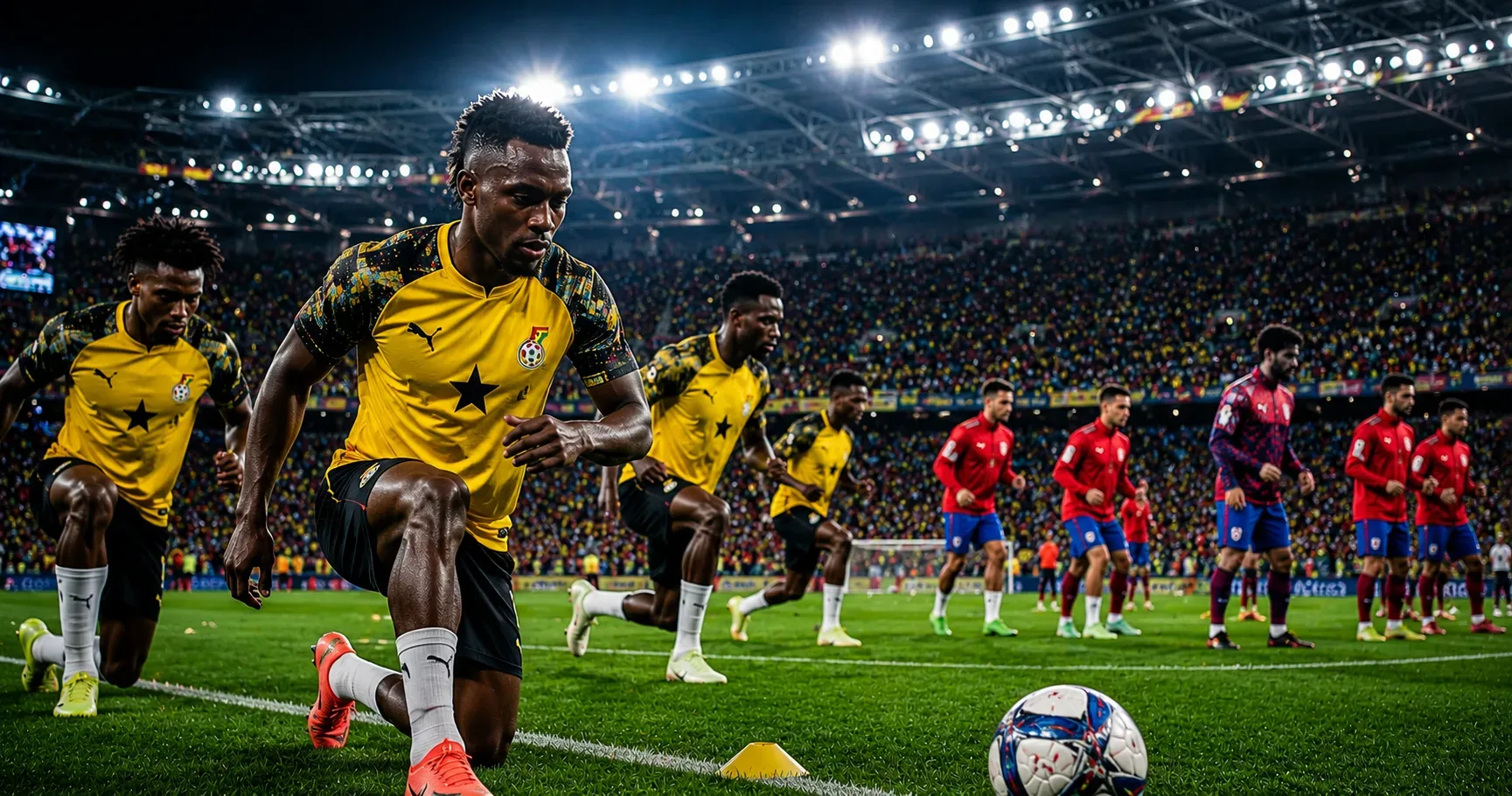
Ghana seeks to regain its historic prominence in the World Cups
The Ghana national team has built a respected history in world football, especially since the 2000s. The Black Stars have gained prominence due to their ability to reveal talented players and the competitiveness demonstrated in major tournaments.
Ghana's greatest moment in World Cups came in 2010, when the team reached the quarter-finals in South Africa and was very close to becoming the first African team to reach a World Cup semi-final. Since then, Ghana has gone through generational changes, but maintains traditional characteristics such as intensity, strength in physical duels and the ability to accelerate attacks.
The current selection combines players with experience in the main European leagues and a new generation looking to write their own chapter in the country's history.
Panama tries to confirm its evolution on the international scene
Panama represents one of CONCACAF's most interesting growth stories in recent decades. The first participation in World Cups took place in 2018, a historic milestone for football in the country.
In recent years, the Panamanian team has consolidated an identity based on collective organization, defensive commitment and a strong competitive spirit. Although they normally face opponents with greater individual technical quality, the team usually compensates for this difference with tactical discipline and intensity during the 90 minutes.
The experience gained in continental and international competitions has made Panama a team more prepared to face high-pressure games.
The tactical confrontation: Ghanaian speed against the organized Panamanian bloc
The tendency is for a balanced match, in which Ghana tries to assume greater offensive protagonism through the speed of its attackers and the ability to win individual duels.
Panama, in turn, can adopt a more strategic stance, seeking to maintain compact lines, reduce spaces in the central sector and take advantage of counterattacks or set pieces.
The battle for midfield will be fundamental. If Ghana manages to accelerate the circulation of the ball and explore the side aisles, they will be able to create important opportunities. If Panama manages to control the pace of the game and avoid spaces, the confrontation could become extremely balanced.
Players and sectors that can decide the confrontation
Ghana's physical and technical capacity
The Ghanaian team traditionally presents athletes with great explosiveness, speed and strength in individual duels. These characteristics can be decisive especially in offensive transitions and open field plays.
Panama’s defensive organization
The Panamanian defensive system will be put to the test against faster players. Communication between sectors, positioning and concentration throughout the match will be essential to maintain balance.
Set balls as a strategic weapon
In games between teams of similar level, set pieces often gain importance. Corners, lateral free kicks and charges close to the box can represent valuable opportunities for both sides.
The World Cup factor: experience, pressure and decisive moments
The World Cup presents an environment unlike any other competition. The emotional pressure, the need to score points and the importance of each error make the details even more relevant.
Ghana has a greater tradition in the tournament and has already demonstrated its ability to face elite teams in previous editions. This history represents an important competitive element in the so-called Copa Factor.
On the other hand, Panama arrives with the advantage of acting without great external pressure, using collective organization as its main weapon to surprise technically superior opponents.
Probable match scenario
The expectation is for a very balanced game, with Ghana having greater offensive initiative and trying to use their individual quality to create differences.
Panama should seek a more controlled confrontation, avoiding spaces, competing intensely in midfield and betting on counterattacks and set pieces.
The first goal could be decisive. An early advantage for Ghana could force Panama to come out more in the game, while a closed score for a long time tends to increase tension and favor a match decided in detail.
Conclusion
Ghana and Panama face a clash of enormous importance within the 2026 World Cup. On one side, an African team with tradition, talent and a history of great campaigns. On the other, an organized, resilient Central American team accustomed to competing as underdogs.
The match promises to be marked by physical intensity, midfield battles and a great strategic component. Although Ghana has a greater tradition in World Cups, the competitive balance of modern football prevents any type of accommodation, especially in a tournament where each point can define the fate of a team.