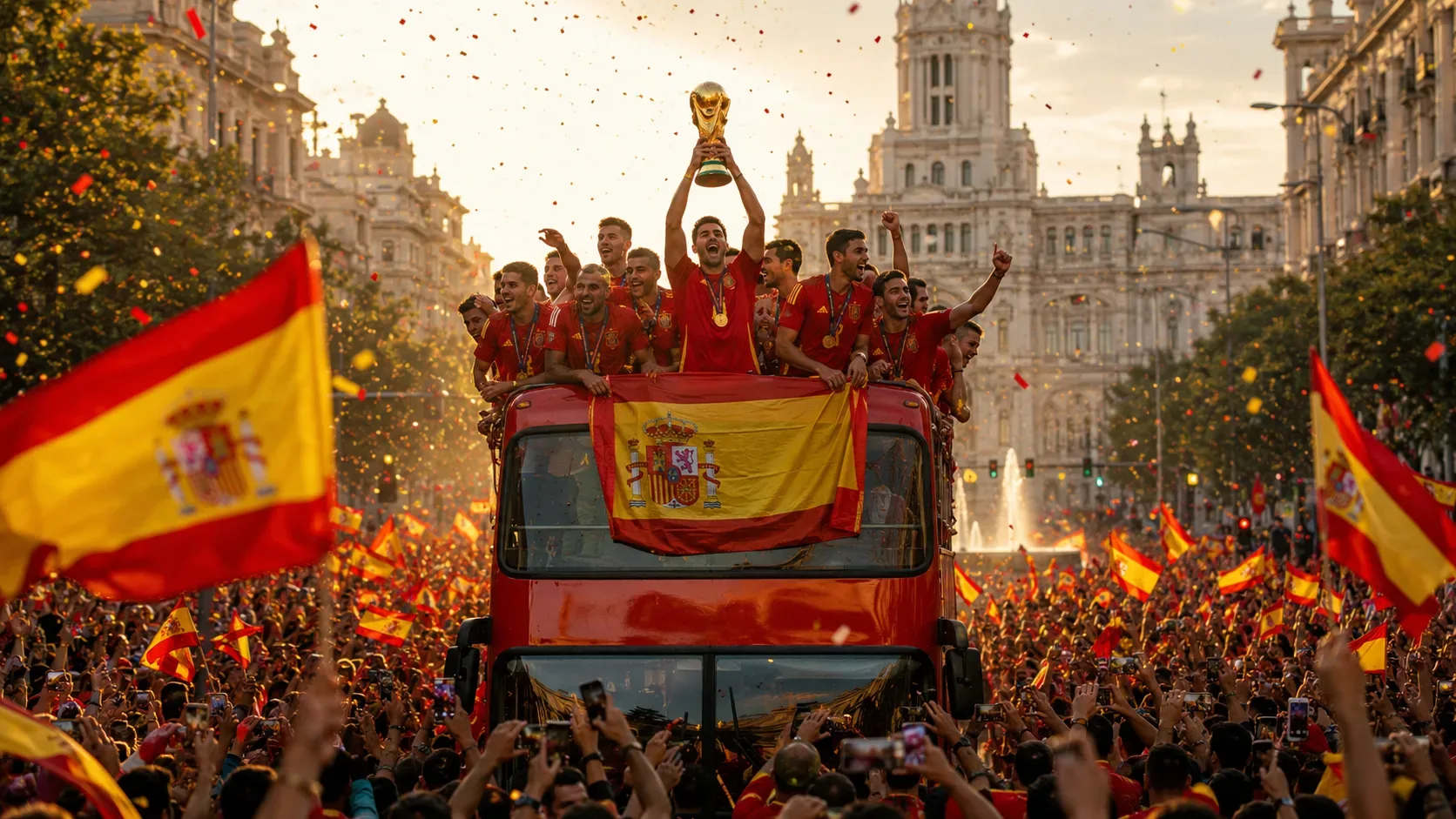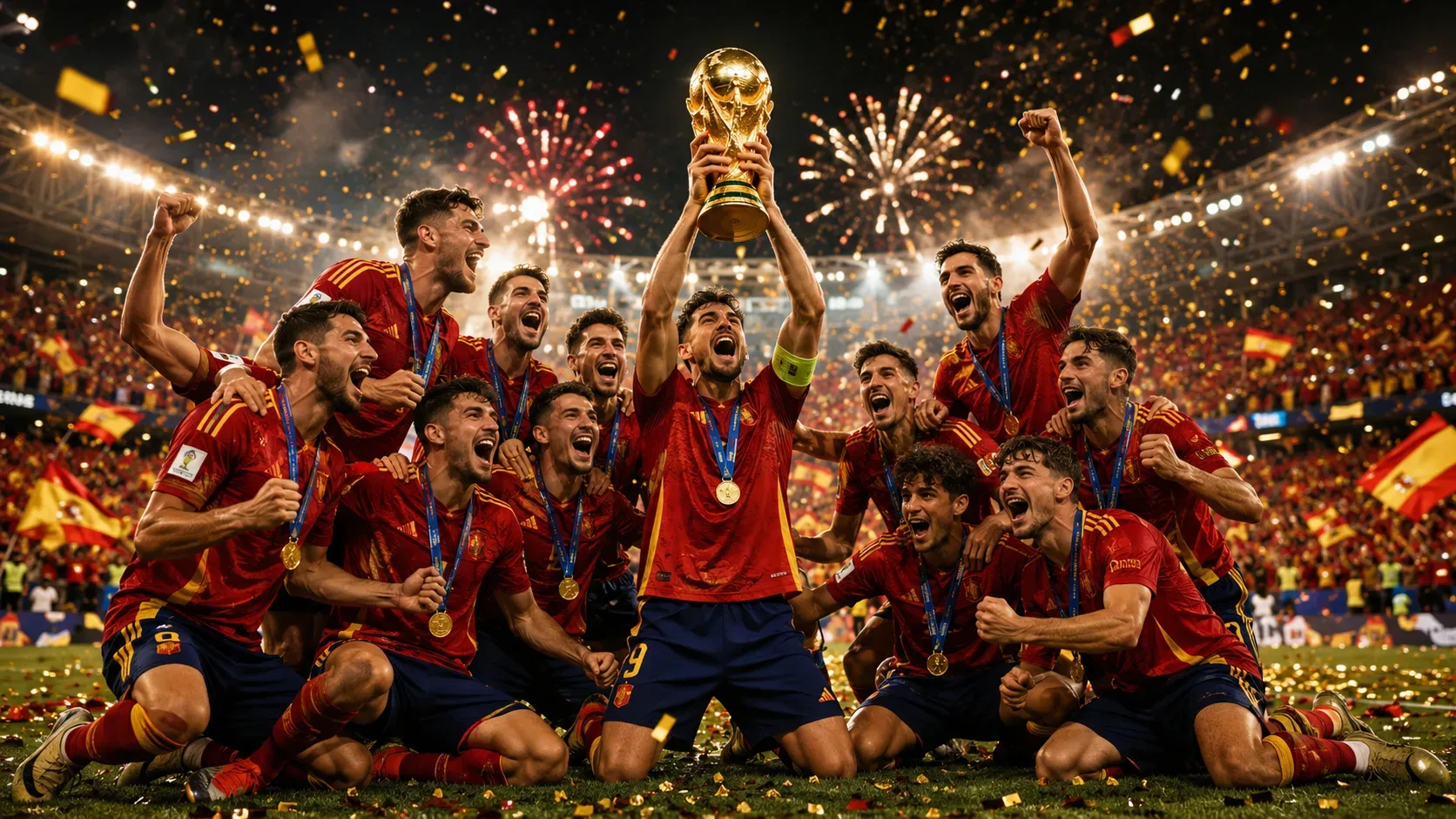
Spain returned to the highest place in world football 16 years after Andrés Iniesta's goal in Johannesburg. This time, the consecration took place in East Rutherford, in the United States, with a 1-0 victory over Argentina in extra time of the 2026 World Cup final.
Ferran Torres, who had started the decision on the bench, scored in the 106th minute and ended a match territorially dominated by the Spanish. Argentina spent 115 minutes without even finishing, while Luis de la Fuente's team persisted until finding the goal that transformed a promising generation into world champions.
The title wasn't born just in that play. It was built during years of renewal, matured with European achievements, resisted injuries, criticism and institutional instability and gained strength with each difficulty faced in the tournament.
This is the story of a Spain that preserved its identity, but learned to be more vertical, more physical, more flexible and, above all, more competitive.
A reconstruction that began long before the World Cup
When Luis de la Fuente took over the main team, in December 2022, his name did not provoke the same international repercussion as other coaches linked to Spanish football. His main credential was his in-depth knowledge of the country's youth teams.
De la Fuente had already worked with several of the players who would later be called up to the senior squad. This coexistence allowed the creation of an environment of trust, in which the coach knew the technical characteristics, behavior and personality of a large part of the squad.
The project quickly showed results. Spain won the 2023 UEFA Nations League, beating Croatia on penalties after a goalless draw, and won the 2024 European Championship with seven wins in seven matches. Rodri was chosen as the best player of that Euro, while Lamine Yamal received the best young player award.
In 2025, the team reached the Nations League final again. They lost the title to Portugal on penalties, after a 2-2 draw, but maintained regularity among the main forces in world football. The defeat would also serve as a lesson for a decisive reunion in the World Cup.
More than a succession of good results, this journey created a winning culture. Spain arrived in North America knowing how to compete in finals, react to difficult moments and live with the pressure of being considered favorites.
Spain's trajectory at the 2026 World Cup
The campaign didn't start with a dominant showing. In their debut, Spain drew 0-0 with Cape Verde, a team making its debut in the World Cup. Roja had the ball, attacked for much of the match, but ran into the opposing defensive organization and the defenses of goalkeeper Vozinha.
The answer came in the next round. Against Saudi Arabia, the team won 4-0, with a much more aggressive performance. Mikel Oyarzabal and Lamine Yamal were among the players who found the net in a match that restored the squad's confidence.
In the last round of Group H, Spain needed to avoid defeat against Uruguay to confirm their classification. The team did not settle for this advantage: they won 1-0, with a goal from Álex Baena, and took the lead.
The table shows how the team grew after the debut and built a campaign marked by defensive efficiency and collective evolution.
| Phase | Departure | Result | Highlight |
|---|---|---|---|
| Group H | Spain x Cape Verde | 0 to 0 | First big difficulty |
| Group H | Spain x Saudi Arabia | 4 to 0 | Offensive recovery |
| Group H | Uruguay x Spain | 0 to 1 | Goal by Álex Baena |
| 16ths of final | Spain x Austria | 3 to 0 | Two goals from Oyarzabal |
| Eighth finals | Portugal x Spain | 0 to 1 | Decisive goal from Mikel Merino |
| Quarter-finals | Spain x Belgium | 2 to 1 | Fabián Ruiz and Merino |
| Semifinal | France x Spain | 0 to 2 | Oyarzabal and Pedro Porro |
| Final | Spain x Argentina | 1 to 0, after extra time | Goal by Ferran Torres |
In the first knockout round, Oyarzabal scored twice and Pedro Porro completed the 3-0 victory over Austria. It was the first Spanish triumph in a World Cup knockout stage since winning the title in 2010.
The rematch against Portugal changed the weight of the campaign
The confrontation with Portugal in the round of 16 represented more than a dispute for classification. The Portuguese had defeated Spain in the 2025 Nations League final, on penalties, a few weeks before the World Cup.
Luis de la Fuente analyzed that final again in search of solutions. The reunion was balanced, physical and tactically demanding. When the possibility of a new extension began to grow, Ferran Torres found Mikel Merino, who scored the winning goal for 1-0.
Overcoming Portugal had a technical and emotional effect. Spain eliminated a rival who knew their style deeply and proved that they could win close matches, even when the ball circulation was not enough to create many clear opportunities.
It was a feature that had been missing in some previous generations: winning even when the game didn't flow.
Belgium and France confirmed the strength of the champion
In the quarter-finals, Belgium were the only team capable of scoring against Spain in the entire World Cup. Still, goals from Fabián Ruiz and Mikel Merino secured the Spanish victory by 2-1.
The result showed the depth of the midfield. If Rodri organized the game from behind, Fabián appeared to speed up circulation and attack spaces. Merino, in turn, became decisive with infiltrations, air force and presence in the area.
The semi-final against France was one of the most complete performances of the campaign. Facing a team considered among the favorites, Spain controlled the spaces, reduced the influence of the French attack and won 2-0, with goals from Oyarzabal and Pedro Porro.
Domination over France revealed the maturity of the project. The team didn't need to accelerate the entire time. He knew how to control possession, press after losing the ball and choose the right moments to attack.
The draw with Cape Verde was the first big warning
The 0-0 debut was treated as a huge surprise. Spain were European champions, had some of the most valued players on the planet and were facing a team that was playing in its first World Cup.
The difficulty that afternoon exposed a familiar problem: possession of the ball did not always turn into clear-cut opportunities. Cape Verde protected the area, reduced the spaces and forced the Spanish to move the ball away from the goal.
Instead of causing a crisis, the result acted as a course correction. Luis de la Fuente himself later stated that the stumble made the team better and contributed to the evolution shown against Saudi Arabia.
Spain started to attack with more speed, look for the back of the field more frequently and better explore the movement of players without the ball. The team continued to value possession, but stopped treating it as an isolated objective.
Injuries almost dismantled the attacking sides
The game against Uruguay brought one of the most worrying situations of the campaign. Nico Williams suffered a muscle problem in his right adductor, while Yeremy Pino left the field with a shoulder injury.
Exams ruled out a fracture in Pino's case, but confirmed a sprain. The Spanish federation classified both injuries as moderate. Lamine Yamal had also started the tournament after recovering from a muscle problem, while Víctor Muñoz was waiting for the physical condition to debut.
The casualties threatened precisely one of Spain's main transformations. Unlike the 2010 champion team, which concentrated much of its actions in the center, the 2026 team depended heavily on the range and individual imbalance of its wingers.
De la Fuente responded by using different formations and players. Oyarzabal could start from the left or take command of the attack. Ferran Torres offered depth. Gavi helped press from more advanced positions, while Nico and Yamal were managed according to their physical conditions.
The ability to replace players without abandoning her identity was one of the champion's greatest strengths.
Rodri was the brain and balance of the team
Rodri arrived at the World Cup after a season marked by physical problems, including recovery from a serious knee injury. Even without going through his most dominant moment individually, he became the team's leadership and organization reference.
As captain, he helped control the pace of matches and provided protection for the defense. It also functioned as a balancing voice within the group, supporting younger players and those receiving fewer minutes.
Its value didn't just appear in passes or recoveries. Rodri allowed full-backs, midfielders and wingers to advance with greater security. When Spain lost the ball, their reading reduced the possibility of opposing counterattacks.
The campaign with just one goal conceded was not the exclusive result of the defenders. It was born from collective pressure, the rational occupation of spaces and the control exercised by the midfield. Spain set a record for the fewest goals conceded by a world champion.
Lamine Yamal and Nico Williams added a new dimension to the game
Lamine Yamal didn't need to dominate every match to be important. Even after arriving at the World Cup with physical doubts, the young man offered dribbling, passes between the lines, set pieces and a constant threat on the right side.
His presence forced defenses to move more players to the sector, opening spaces for midfielders and Pedro Porro's infiltrations. Yamal also appeared in important moments in the group stage and ended the competition as one of the team's main creative references.
On the opposite side, Nico Williams added speed and the ability to face the marker one-on-one. Even though he was hampered by injuries during the tournament, he participated in the title goal by returning Pedro Porro's cross to Ferran Torres.
The duo symbolized the evolution of Spanish football. The team still knew how to control games with passes, but they could also attack at speed, open the field and overcome opponents through individual actions.
Oyarzabal, Merino and Porro were the heroes who shared the spotlight
Spain did not depend on a single goalscorer. His decisive goals were distributed between players of different positions and characteristics.
Mikel Oyarzabal scored twice against Austria and found the net again in the semi-final against France. Mikel Merino decided the match against Portugal and also scored against Belgium. Pedro Porro scored goals in the first knockout phase and in the semi-final.
Fabián Ruiz, Álex Baena and Lamine Yamal also left their marks during the campaign. Ferran Torres, in turn, saved his first goal of the tournament for the most important moment of all: extra time in the final.
This distribution made selection less predictable. When a winger was neutralized, the midfielders attacked. When the center forward didn't find space, the full-backs appeared. When a member needed to leave, the bank maintained a competitive level.
The silent defense supported the offensive football
Spain finished the World Cup with 14 goals scored and only one conceded. Belgium were the only team capable of overcoming their defense.
Unai Simón had security when required. Pau Cubarsí showed maturity and even avoided a dangerous chance from Argentina in the final minutes of the decision. Aymeric Laporte offered experience, quality in passing the ball and strength in duels.
The full-backs also played a decisive role. Pedro Porro did not limit himself to scoring and directly participated in important goals. Marc Cucurella helped maintain intensity, amplitude and aggression on the left side.
The system worked because everyone defended it. The wingers pressed the opponent's exit, the midfielders closed passing lines and the block recovered the ball quickly. The champion's defense began long before the opponent approached the area.
Off-field problems did not interrupt the project
The men's national team cycle developed amid one of the most turbulent institutional phases of the Royal Spanish Football Federation.
The entity faced the crisis caused by the case involving former president Luis Rubiales after the 2023 women's World Cup final. In 2024, the federation was also the target of an investigation into possible irregularities and corruption, in a period of strong administrative instability.
Luis de la Fuente, who initially faced distrust from part of the press, managed to preserve the atmosphere of the main team. His knowledge of the players and the construction of an atmosphere described as familiar were highlighted as relevant factors for the continuity of the project.
During the World Cup itself, another controversy arose before the semi-final. An article by former Prime Minister Mariano Rajoy questioned the French identity of black players on the France national team. The Spanish government repudiated the statements and apologized, classifying the comments as xenophobic.
The episode generated diplomatic noise on the eve of a decisive match. On the field, however, the team maintained its concentration and delivered one of its best performances in the tournament.
The final: dominance, tension and the goal that took 106 minutes
Argentina entered the field as current world champions and with the experience of Lionel Messi, Emiliano Martínez and several winning players in 2022.
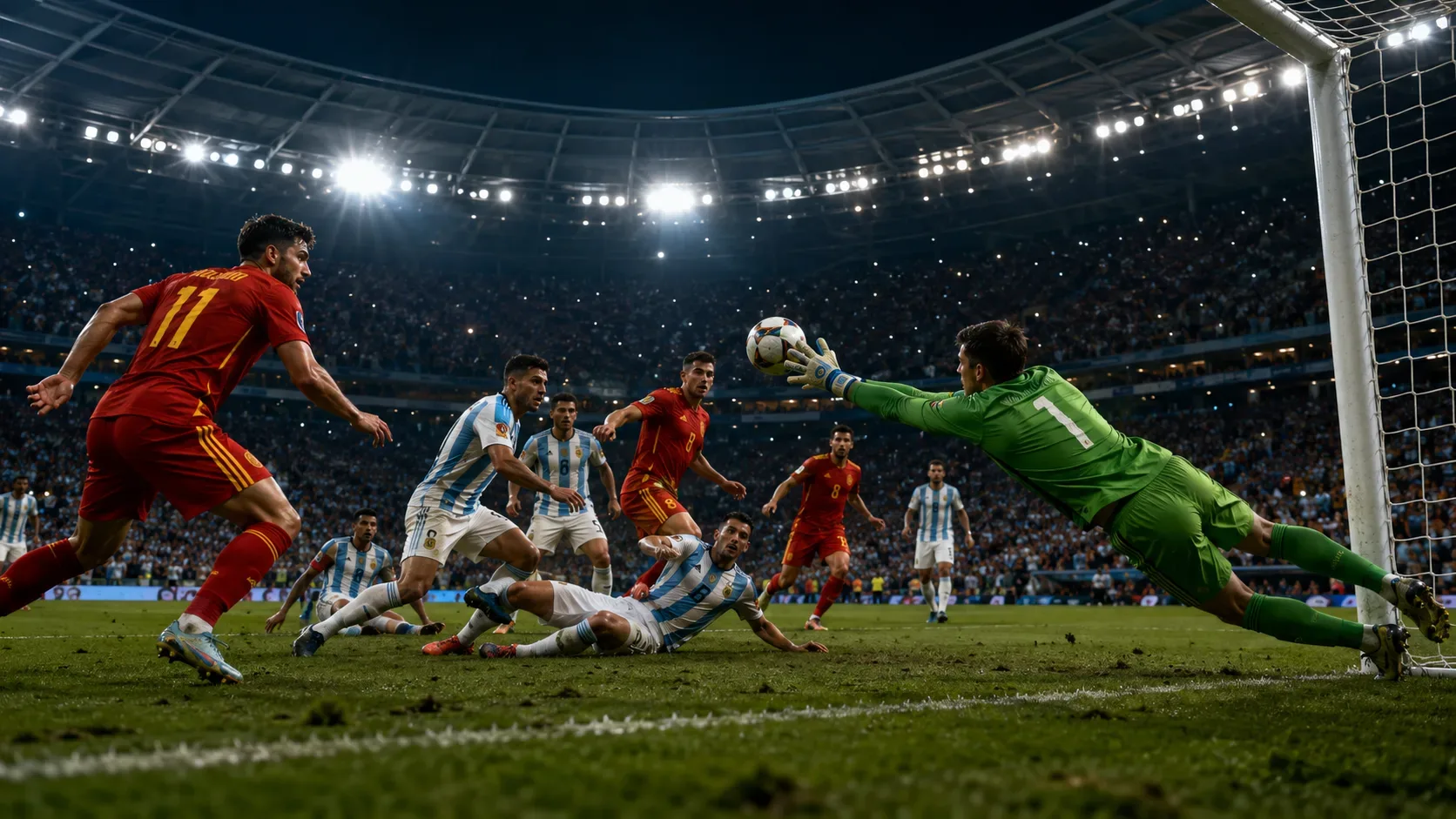
Spain took control from the beginning. Lamine Yamal created the first big opportunity in the opening minutes, but Emiliano Martínez started a performance that would end with a record 12 saves in a World Cup final.
Time passed and Spanish superiority was not turned into a goal. Argentina defended close to their area, interrupted the rhythm and tried to lead the decision into a scenario of greater tension.
In stoppage time of the second half, Enzo Fernández received a second yellow card and was sent off. Even with an extra player, Spain still had to control their anxiety during extra time.
Nico Williams scored in the 96th minute, but the goal was disallowed due to a foul by Mikel Merino during the play. Shortly afterwards, Merino headed close to the post. The feeling was that the match could escape despite the extensive Spanish dominance.
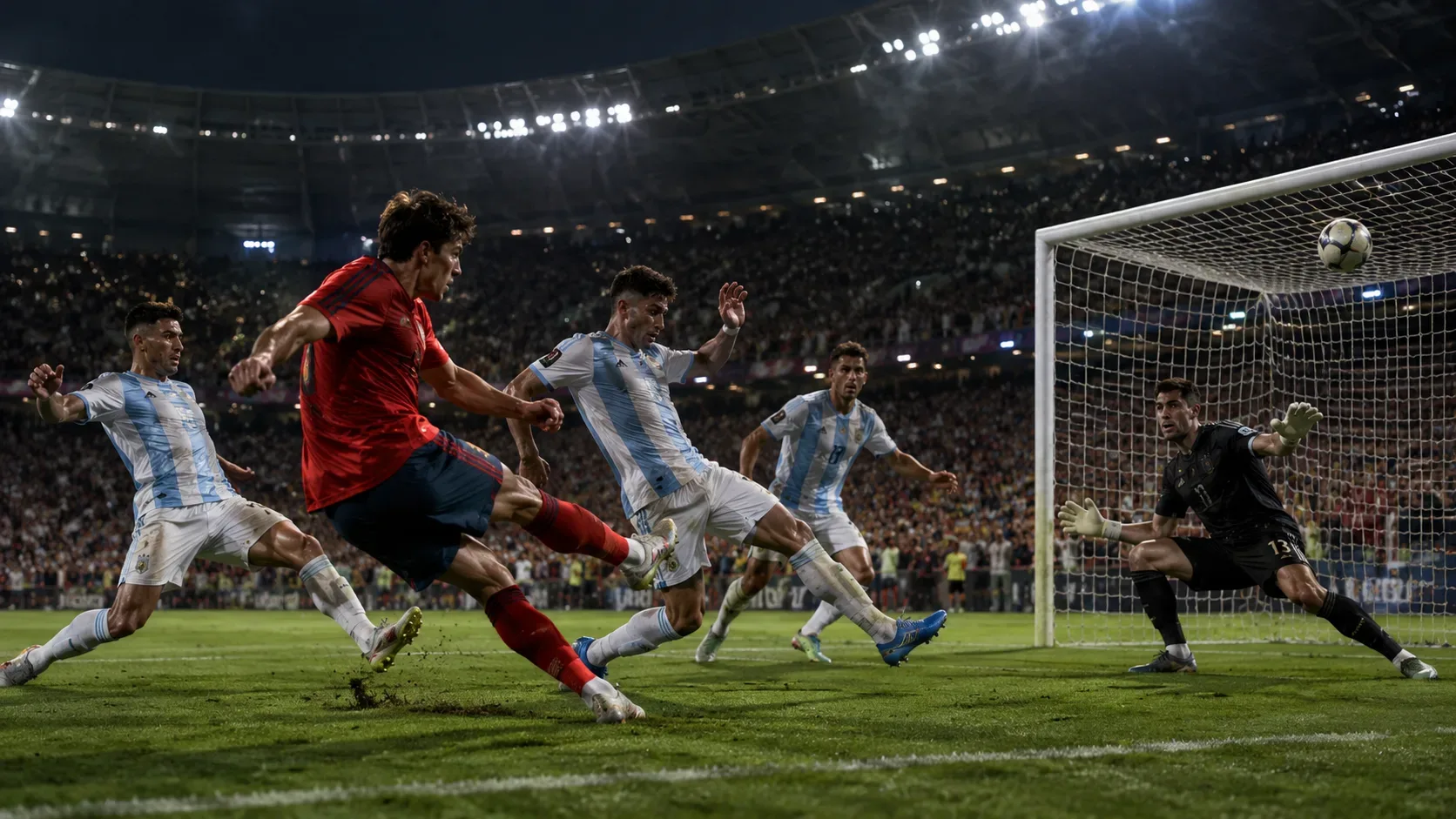
Then, in the 106th minute, Pedro Porro crossed from the right. Nico Williams returned a header to the center of the area and Ferran Torres appeared to finish with his left leg.
The goal brought together three fundamental elements of the campaign: Porro's depth, the strength of the wingers and the importance of the bench.
Argentina still tried to react in the final minutes. Cubarsí avoided a dangerous finish after a low cross, and Giovanni Simeone wasted Argentina's best chance by sending the ball over. Spain resisted and confirmed the victory by 1-0.
Why Spain won the 2026 World Cup
The Spanish title can be explained by a combination of factors.
- Well-defined identity: the team knew how to control the ball, occupy spaces and press after losing possession.
- Tactical evolution: Spain maintained its passing tradition, but incorporated speed, width and more direct attacks.
- Squad depth: players who started matches on the bench decided important clashes.
- Defensive strength: only one goal was conceded throughout the competition.
- Decision-making experience: a large part of the group had already won the 2023 Nations League and the 2024 Euro Cup.
- Integration between generations: Rodri, Laporte and Unai Simón offered experience, while Yamal, Cubarsí and other young people brought energy and creativity.
- Management of Luis de la Fuente: the coach knew several athletes from the youth categories and managed to maintain unity even in the face of injuries.
- Adaptability: Spain won dominant games, physical confrontations, balanced matches and a final that required patience for 120 minutes.
It wasn't just the most talented selection. It was the team that presented the most alternatives to solve the different problems posed by the competition.
A new golden era of Spanish football
The achievement of 2026 placed Spain once again among the two-time world champion teams, alongside the teams that managed to win the tournament more than once.
The first title had been won in 2010, with a generation made up of Casillas, Puyol, Xavi, Iniesta, Busquets, David Villa and other historic names. The 2026 team didn't try to copy that group. Built your own identity.
The current generation has also consolidated a sequence of impressive results: champion of the League of Nations in 2023, champion of the European Championship in 2024, runner-up in the League of Nations in 2025 and world champion in 2026.
Luis de la Fuente, at 65, became the oldest coach to win a World Cup. Spain also extended its undefeated streak and simultaneously held the men's and women's world titles, an unprecedented feat in national team football.
The champion who turned control into courage
The Spain of 2026 will be remembered for the ball at its feet, the almost impenetrable defense and the youth of some of its protagonists. But his greatest quality was perhaps his ability to continue believing when his dominance didn't result in goals.
The team survived the scare against Cape Verde, responded to injuries, eliminated Portugal in a rematch, overcame Belgium and France and faced an experienced Argentina without abandoning its proposal.
In the final, he had a goal disallowed, saw Emiliano Martínez make a sequence of saves and reached the second half of extra time without being able to transform superiority into advantage. Even so, he didn't give up playing.
Ferran Torres scored the goal, but the title belonged to an entire group. To starters and reserves. To young people and veterans. To the players who decided games and those who protected the system so others could shine.
Sixteen years after Iniesta, Spain returned to the top of the world. Not repeating the past, but proving that your football school continues to be capable of renewing itself, learning and winning.