Spain turned the first half of extra time in the World Cup final into an almost permanent attack on the Argentine defense. With one more player since Enzo Fernández's expulsion, the Spanish team controlled the ball, occupied the offensive field and found the net, but were unable to change the score.
Argentina, already practically without offensive presence during normal time, retreated even further to protect the area and survive the first 15 extra minutes. Emiliano Martínez was once again decisive, while the Argentine defenders withstood the pressure and kept it 0-0 before the second half of extra time.
Spain took complete control of extra time
Numerical superiority has set the stage since the restart. Enzo Fernández had received his second yellow card in the 90+3 minute, after arriving late in a dispute with Pau Cubarsí. With ten players, Argentina abandoned any more consistent attempt to put pressure on the Spanish exit and started to defend very close to their own area.
Spain kept their players forward, moved the ball from one side to the other and tried to open spaces especially through the aisles. Pedri sought to accelerate combinations inside, while Nico Williams offered depth and dribbling ability on the left side.
Spanish dominance, however, continued to present the same problem observed during the 90 minutes: a lot of territorial control, but difficulties in transforming possession into really clean opportunities. Argentina allowed pressured crosses and shots, mainly protecting the central region of the area.
Pedri and Nico Williams created the first danger
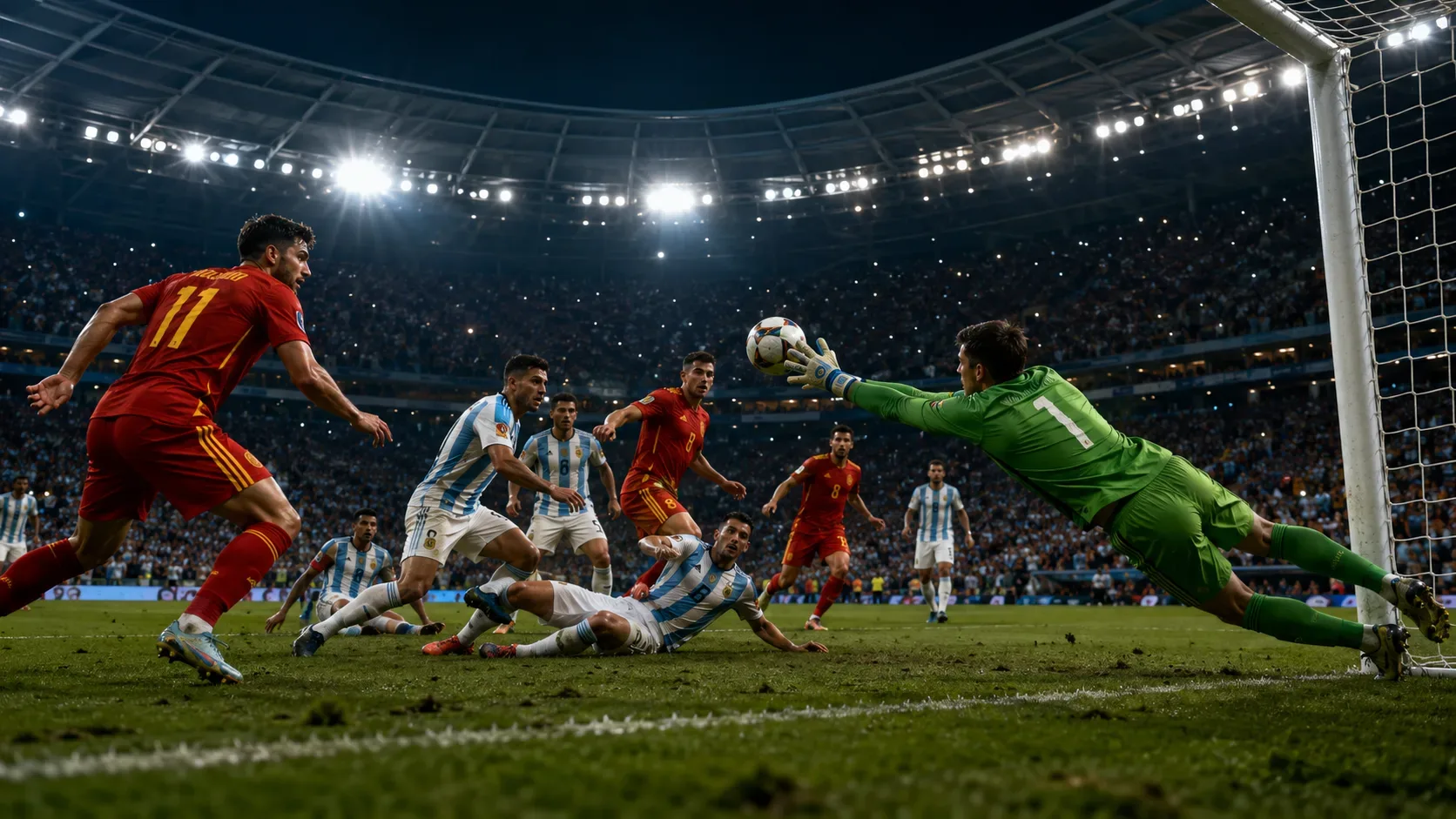
The first relevant arrival came in the 93rd minute. Pedri was given space to lift a faster ball towards the box, Nico Williams headed the ball away and Emiliano Martínez made the save.
The move did not represent a clear scoring opportunity, and there was doubt about the position of the Spanish striker, but it confirmed the extra-time script: Spain attacking, Argentina defending and Dibu Martínez appearing whenever the ball passed through the defensive block. It was yet another intervention in a performance that already accumulated a large number of defenses in the decision.
Spain scored, but the goal was disallowed
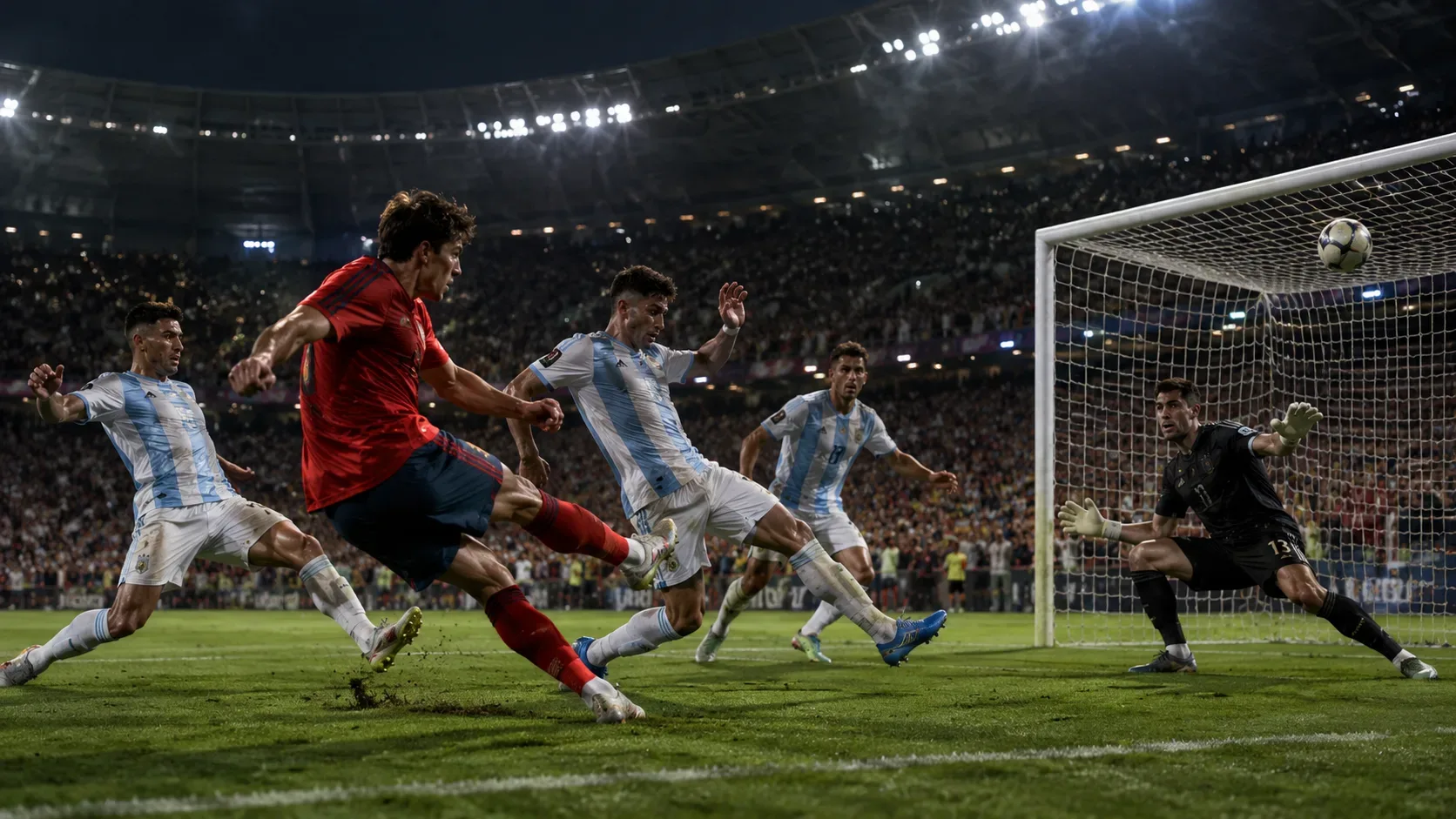
The most important moment of the first half of extra time occurred in the 96th minute. After a dispute inside the area, the ball was free for Nico Williams to score and start the Spanish celebration.
The referee, however, scored a foul by Mikel Merino on Nicolás Otamendi before the finish. The images showed Merino stepping on the Argentine defender's foot during the dispute, and VAR confirmed the decision on the field. The score remained zero.
The move made it clear how Argentina was at its limit. The defense managed to prevent most of the plays from ending in dangerous shots, but they no longer had the strength to keep the game away from their area. Each ball hit remained under Spanish control, fueling a new offensive sequence.
Spanish changes preserved intensity
Spain also had to manage the physical strain. Rodri and Aymeric Laporte left the field during the first half of extra time, with Martín Zubimendi and Eric García entering to keep the ball circulating and safe against a possible Argentine transition.
Rodri's departure removed its main organizer from the team since the start of the match. Zubimendi took on the role of receiving from defenders, controlling second balls and preventing Messi or Julián Álvarez from finding space to launch a counterattack.
Even with the changes, the Spanish stance has not changed. The team remained installed in the Argentine field, although without being able to significantly increase the speed of the plays in the final minutes of the period.
Argentina did not attack, but achieved its objective
Argentina practically created no opportunities in the first half of extra time. Messi and Julián Álvarez were isolated, receiving long balls while outnumbered and without enough support to sustain possession.
The Argentine objective became evident: to close the spaces, slow down whenever possible and take the decision to penalties. During normal time, the team had already finished without recording a shot, while Spain accumulated 15 attempts and forced Emiliano Martínez to make ten saves.
Playing this way involves enormous risk. A positioning error, a rebound or a poorly defended cross could decide the title. Still, Argentina managed to survive the first 15 extra minutes despite playing with one less player.
Best players from the first half of extra time
Emiliano Martínez
Dibu Martínez continued as the main person responsible for Argentina's stay in the decision. In addition to defending Nico Williams' deflection, he demonstrated confidence in crossed balls and maintained concentration against an opponent who controlled almost all actions.
Nico Williams
The striker was the most dangerous Spaniard of the period. He participated in the first shot of extra time, attacked the spaces on the left and even put the ball in the net, although the goal was correctly disallowed for a previous foul.
Pedri
Pedri added creativity and speed to Spanish actions. It was his cross that created Martínez's defense at the beginning of extra time and a large part of the attempts to speed up the movement against the Argentine block also came from his feet.
Nicolás Otamendi
Otamendi led a defense under intense pressure. The veteran protected the area, won important contests and suffered the foul that caused the Spanish goal to be disallowed.
Mikel Merino
Despite the foul in the disallowed goal, Merino was important for his presence inside the area. His infiltrations forced the Argentine defense to retreat even further and opened spaces for Nico Williams and Ferran Torres.
What to expect from the second half of extra time
Spain should increase the pressure from the first minutes. With Argentina tired and outnumbered, the tendency is for the Spanish team to intensify its crosses, quick reversals and the entries of Pedri, Merino and Ferran Torres into the area.
To turn dominance into a goal, however, the Spanish need to avoid predictable circulation. Just moving the ball around the defensive block favors Argentina. Spain needs to combine quick passing, overtaking and finishing before the defense can reorganize itself.
Argentina are unlikely to change their strategy as long as the score is tied. The team must remain compact, use Messi as a possible launcher and try to find Julián Álvarez in an isolated sprint. Any opportunity for a counterattack could represent Argentina's only chance before penalties.
The psychological factor also gains importance. Spain knows that it has numerical superiority and that wasting this advantage could lead to a dispute against one of the most decisive goalkeepers in world football. Argentina, on the other hand, gains confidence with every minute they manage to maintain a draw.
Spain is closer to the goal, but the clock favors Argentina
The first half of extra time confirmed Spanish superiority, but also reinforced Argentine resistance. Spain dominated, created the best plays and scored, but still hasn't found a valid shot capable of overcoming Emiliano Martínez.
There are 15 minutes left to avoid penalties. Spain enters the decisive period with more players, more possession and greater creative capacity. Argentina enters with Dibu Martínez, experience in decisions and the conviction that survival could be enough to transform a match dominated by the opponent into another world title.