Spain increased the pressure, controlled practically all offensive actions and turned the second half of the World Cup final into a constant attack against the Argentine defense. The Spanish volume, however, was not enough to remove the zero from the scoreboard.
Argentina spent much of the final stage protecting their own area, unable to involve Lionel Messi and Julián Álvarez. Emiliano Martínez avoided the Spanish goal at different times and kept the South American team alive. In stoppage time, Enzo Fernández's expulsion further increased Spain's territorial advantage, but the score remained 0-0 until the final whistle, taking the decision to extra time.
Spain came back from the break ready to accelerate
After a first half with just three shots — all Spanish —, Spain came back attacking from the first seconds. With less than a minute, high pressure recovered the ball in the offensive field and Álex Baena finished from outside the area, forcing Emiliano Martínez to make a safe save.
Argentina responded by winning their first corner in the 48th minute, but were unable to turn the play into a real opportunity. The scenario soon returned to the pattern of the first half: Rodri controlling the center of the field, the Spanish defenders advancing and the Argentines positioned close to their own area.
Spain started to circulate the ball with greater speed, looking mainly for Lamine Yamal on the right and Dani Olmo between the lines. The best construction of the opening minutes came in the 55th minute, when a combination between Oyarzabal and Fabián Ruiz was interrupted inside the area. Yamal appeared free on the side, but didn't receive the pass that could have put him in a better position to finish.
Argentina practically abandoned the attack
While Spain looked for alternatives, Argentina adopted an increasingly defensive stance. Leandro Paredes came on at half-time in place of Nicolás González, reinforcing the midfield and bringing the Argentine lines closer.
The change helped protect the edge of the box, but also further isolated Messi and Julián Álvarez. Unable to build from the defense, the Argentine team started to resort to long throws, often recovered by Spain.
In the 70th minute, Argentina became the first team since detailed records began to remain without a shot during the opening 70 minutes of a World Cup final. Messi had just 20 contacts with the ball during regulation time, a consequence of Argentina's difficulty in maintaining possession and reaching the offensive field.
In the final minutes, the territorial difference became even more evident: Spain accumulated 22 contacts in the opponent's area, while Argentina had just one. The European team also controlled approximately 90% of possession in the final quarter of an hour.
The substitutions made Spain more aggressive
Luis de la Fuente realized that the dominance was not being converted into clear chances and made important changes in the 62nd minute. Pedri and Ferran Torres replaced Fabián Ruiz and Mikel Oyarzabal.
Pedri brought more vertical passes and greater speed in circulation. Ferran began to occupy the area more frequently, offering a reference for crosses from Yamal and the full-backs.
The answer appeared quickly. In the 64th minute, Dani Olmo finished from outside the area. Emiliano Martínez was unable to handle the ball, which had a dangerous effect and went close to the post before going out for a corner.
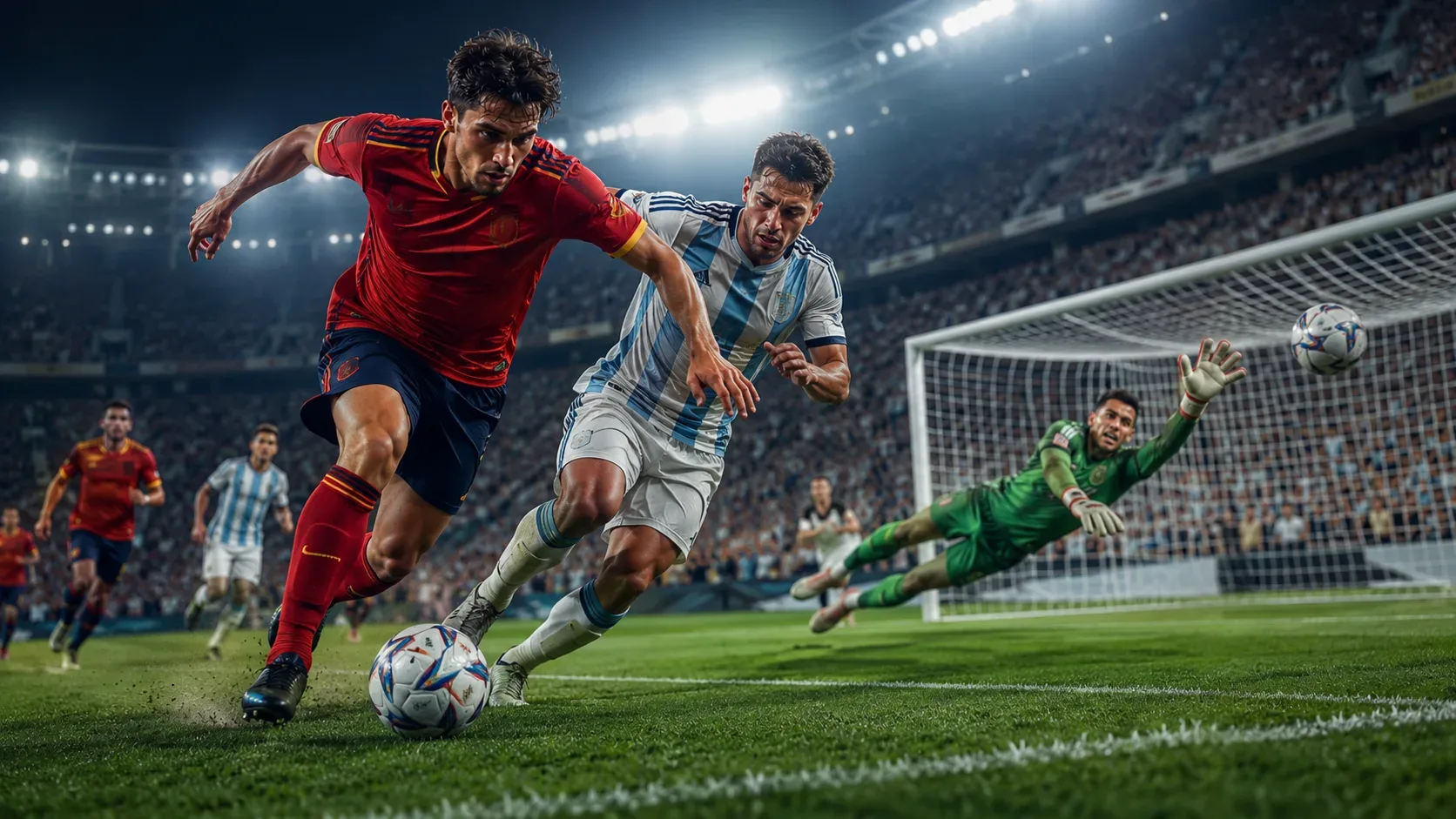
Three minutes later, Yamal received the ball on the right, reached the baseline and set it up for Ferran Torres. The striker managed to head it downwards, but the completion went towards Martínez, who saved without giving a rebound. It was an important opportunity, although it cannot be classified as a missed goal.
In the 75th minute, Nico Williams and Mikel Merino replaced Baena and Olmo. Spain started to attack with two wingers wide open, while Merino looked for infiltrations and disputes from the top inside the area.
Emiliano Martínez prevented the dominance from turning into a goal
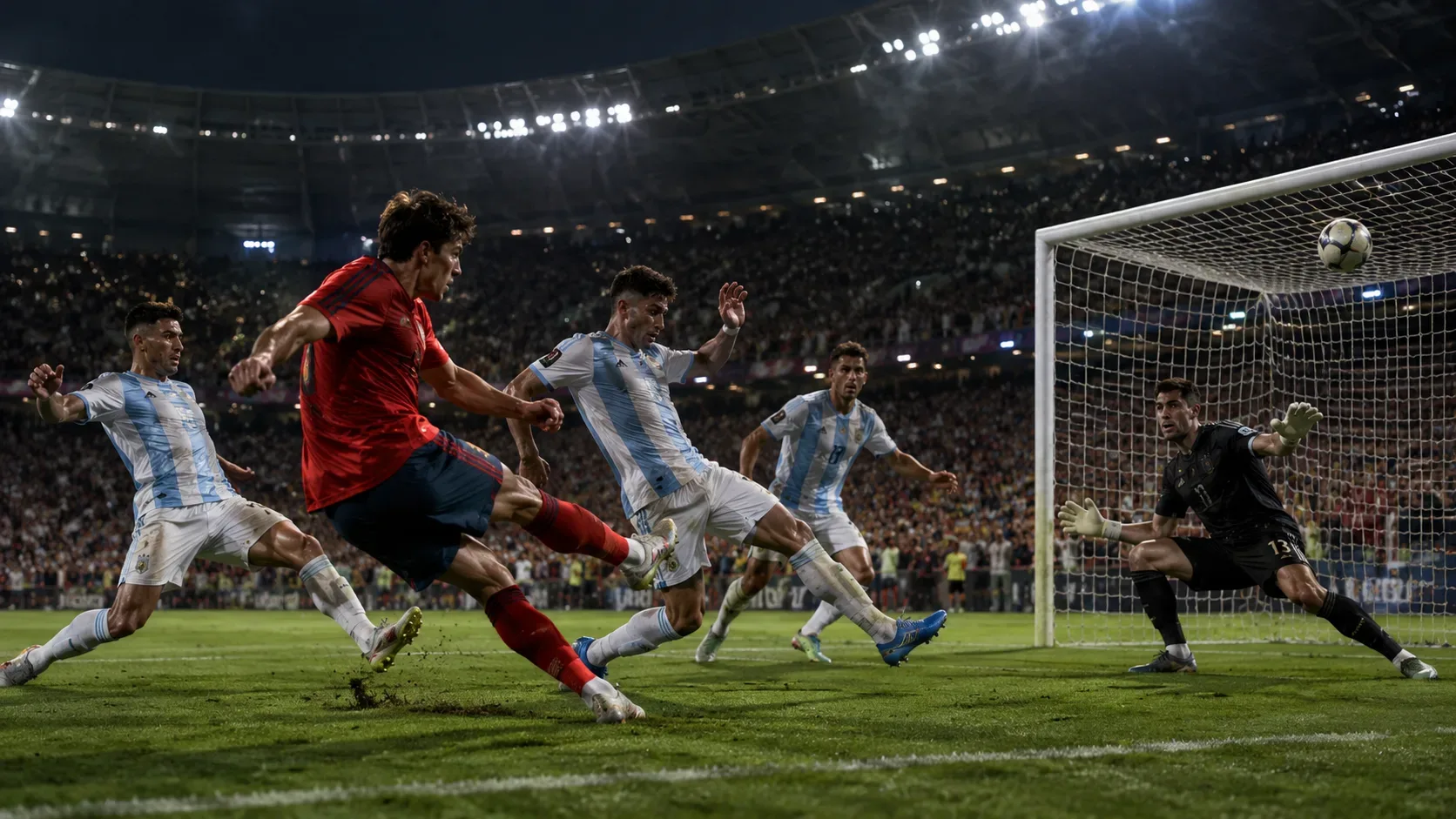
The Spanish pressure reached its most intense moment after the 75th minute. Pedri received the ball at the edge of the area and finished for Martínez to save. Next, Pau Cubarsí risked from approximately 25 meters. The ball went towards the goalkeeper, but he misjudged the movement and almost deflected it into his own goal.
In the 78th minute, Spain already had ten shots, seven of which went towards the goal. Argentina had not yet attempted any conclusions. Shortly afterwards, Aymeric Laporte appeared inside the box and headed a cross from wide, but Martínez was again well placed.
In stoppage time, Nico Williams led a counterattack with two teammates available. The attacker decided to finish instead of making the pass, and Martínez made another save. Then, Rodri took a risk from distance and sent it over the goal.
The last big opportunity came from a free kick from Lamine Yamal. The young Spaniard hit directly at goal and forced Emiliano Martínez to make his most difficult save before the end of regulation time.
The expulsion of Enzo Fernández changed the scenario of the final
Enzo Fernández received a yellow card in the 82nd minute for a complaint. In stoppage time, the midfielder arrived late and brought down Pau Cubarsí. The referee presented the second yellow card and, consequently, the red card.
Argentina ended regulation time with ten players, just when they were already facing difficulties leaving their own area. The expulsion did not have enough time to produce a change in the score, but it created a huge problem for Lionel Scaloni to manage during extra time.
In addition to reorganizing the marking, the Argentine coach will need to decide whether to keep two players in attack or remove one of them to rebuild the midfield. Remaining with Messi and Julián Álvarez offers a threat on counterattacks, but could leave the team excessively exposed to the Spanish volume.
Who dominated the second half?
Spain completely dominated the final stage. The European team controlled possession, recovered the ball quickly after losses and spent long periods around the Argentine area.
Spanish dominance cannot be measured solely by the number of passes. Spain also created the best shots, frequently occupied the opponent's area and prevented Messi and Álvarez from participating in the game.
Argentina was efficient defensively, but produced little with the ball. Scaloni's team remained competitive thanks to the organization of the defenders, the coverage of the midfielders and, mainly, the performance of Emiliano Martínez.
The table summarizes the behavior of the two selections during the second half.
| Appearance | Spain | Argentina |
|---|---|---|
| Territorial control | Dominated the offensive field | Remained close to the area itself |
| Creating opportunities | Submissions from Olmo, Torres, Pedri, Cubarsí, Williams and Yamal | Practically did not threaten Unai Simón |
| Changes | Entries increased speed and presence in the area | Changes prioritized defensive protection |
| Main highlight | Collective pressure and Rodri's control | Emiliano Martínez's defenses |
| Situation after 90 minutes | Eleven players and offensive initiative | Ten players after Enzo Fernández's expulsion |
Best players of the second half
Emiliano Martínez
Even with Argentina being dominated, Emiliano Martínez was the main player in the final stage. The goalkeeper made interventions on shots from Olmo, Ferran Torres, Pedri, Cubarsí, Laporte, Nico Williams and Yamal.
Not all conclusions presented great difficulty, and the Argentine even demonstrated insecurity in some long-distance shots. Still, his participation was decisive in keeping the score at zero.
Rodri
Rodri controlled the midfield, collected the balls cleared by the Argentine defense and prevented Messi from receiving the ball in favorable conditions. His presence allowed the Spanish defenders to play more advanced and for Spain to remain installed in the offensive field.
The midfielder made a mistake by forcing a long-range shot in stoppage time when Mikel Merino appeared free on the side, but his collective influence was enormous.
Pedri
Pedri's entry changed Spain's rhythm. The midfielder accelerated his circulation, tried more aggressive passes and appeared at the edge of the area to finish.
His ability to play in tight spaces will be even more important against an Argentina that will likely defend with almost every player behind the ball in extra time.
Pau Cubarsí
In addition to participating in the build-up from the defense, Cubarsí risked a dangerous shot from outside the area and suffered the foul that led to Enzo Fernández's expulsion.
The defender was also important in anticipating launches and keeping Spain pressing without needing to retreat their lines.
Lamine Yamal
Yamal continued to be the most unpredictable player in the Spanish attack. He participated in the creation of Ferran Torres' header, took a free kick against the wall and almost decided the game with the last kick of regulation time.
Argentina managed to limit their infiltrations into the center, but did not prevent the young man from creating dangerous situations down the right aisle.
Result after regular time
Spain 0 x 0 Argentina.
The score took the 2026 World Cup final into extra time. Spain ended the 90 minutes with ample dominance, but without being able to overcome Emiliano Martínez. Argentina advanced to the additional period with ten players after Enzo Fernández was sent off in the 93rd minute.
The result did not reflect the difference in offensive production between the teams. At the same time, Spain also wasted opportunities to transform territorial control into cleaner chances, making several shots from medium distance or directly into the hands of the goalkeeper.
What to expect from the extension?
The trend is for an even more aggressive Spain. With an extra player, Nico Williams and Lamine Yamal should receive more individual confrontation situations on the sides. Mikel Merino could become a decisive player by attacking crosses and occupying space between defenders.
Pedri should assume greater responsibility for creation from within, while Rodri will remain protecting the team against possible counterattacks.
Argentina must set up a compact defensive line, reduce spaces close to the area and manage physical wear and tear. Messi's presence will continue to offer the possibility of an individual play, foul or unexpected pass, even if he played little during the 90 minutes.
For Spain, the biggest risk will be to transform numerical superiority into anxiety. The team will need to move the Argentine defense, alternate attacks from the sides and avoid hasty finishes.
For Argentina, every minute without conceding a goal will increase the possibility of taking the decision to penalties, a scenario in which the presence of Emiliano Martínez represents an important source of confidence.
A final controlled by Spain, but still completely open
The second half confirmed Spanish superiority in possession, occupation of the field and creation of opportunities. Argentina resisted thanks to the defensive organization and Emiliano Martínez, but ended the regulatory period without being able to involve Messi and even lost Enzo Fernández to expulsion.
Spain enters extra time as favorites due to what they presented and their numerical advantage. However, World Cup finals are also decided by the ability to withstand pressure, capitalize on a mistake or survive until penalties.
After 90 minutes of Spanish dominance and Argentine resistance, the title remains without an owner.