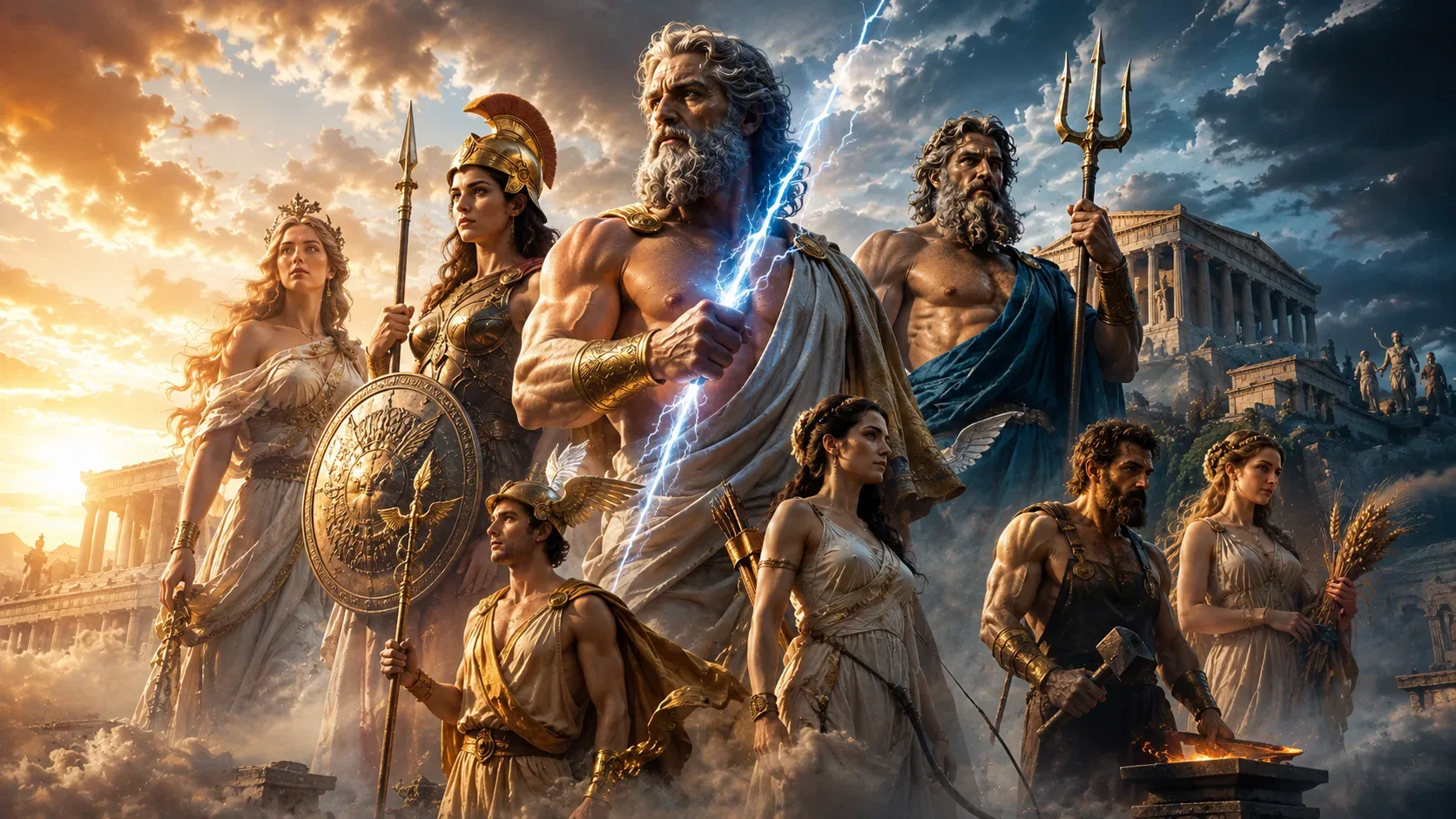
The origin of the Greek gods and the birth of Olympus
Greek mythology presents a complex divine genealogy. According to the narratives recorded by poets such as Hesiod in Theogony, everything began with Chaos, the primordial condition from which the first cosmic entities emerged, such as Gaia (the Earth), Uranus (the Sky), Tartarus and Eros.
From the union between Gaia and Uranus, the Titans were born, extremely powerful beings who ruled the universe before the Olympic gods.
The youngest of the Titans, Kronos, led a revolt against his father Uranus and took control of the cosmos. However, a prophecy said that he would also be defeated by one of his own sons.
To avoid this fate, Cronos began to swallow his children shortly after birth. However, his wife Rhea managed to save the youngest, Zeus, by hiding him on the island of Crete.
When he reached adulthood, Zeus returned, freed his brothers and began a great war known as Titanomachy, the conflict between the Olympian gods and the Titans that would decide the future of the universe.
Who were the 12 gods of Olympus?
After their victory over the Titans, Zeus and his allies established their kingdom on Mount Olympus, becoming the main gods worshiped by the Greeks.
Although there are variations in the list depending on time and tradition, the twelve best-known Olympic gods are:
Zeus – the king of the gods
Zeus was the ruler of the sky, lightning, storms and divine order.
Its most famous symbol was the thunderbolt, a weapon created by the Cyclops during the war against the Titans. As king of Olympus, he was responsible for maintaining justice between gods and mortals.
He was also known for his countless love relationships, from which several gods and heroes of mythology were born.
Hera – queen of Olympus
Wife and sister of Zeus, Hera was the goddess of marriage, family and the protection of women.
In legends, he often appears as a proud and vengeful deity, especially against lovers of Zeus and the children born of these relationships.
His sacred animal was the peacock.
Poseidon – lord of the seas
Brother of Zeus, Poseidon ruled all the oceans.
With his powerful trident, he was capable of creating storms, earthquakes and large waves.
The Greeks, who depended heavily on the sea for trade and survival, considered Poseidon to be one of their most important deities.
Hades – ruler of the underworld
Although he is one of the children of Cronus and Rhea, Hades was not normally part of the twelve Olympians as he ruled the underworld.
He was responsible for the kingdom of the dead, where souls arrived after the end of life.
Different from the modern image of a purely evil being, Hades was seen by the Greeks as a harsh but fair ruler.
Athena – the goddess of wisdom and strategy
Athena represented intelligence, military strategy, justice and craftsmanship.
According to myth, she was born fully armed from the head of Zeus.
She was the protective goddess of the city of Athens and her symbol was the owl, associated with wisdom.
Ares – the god of war
Ares symbolized the most violent, chaotic and destructive side of combat.
Unlike Athena, who represented strategy and military discipline, Ares personified the fury of battle.
His symbol was linked to the spear, shield and combat animals.
Aphrodite – the goddess of love and beauty
Aphrodite was associated with love, desire, fertility and beauty.
There are different versions about its origin, the most famous being the one in which it is born from sea foam after the fall of Uranus.
His influence appeared among both gods and humans.
Apollo – the god of light, music and knowledge
Apollo was one of the most admired deities of Ancient Greece.
It was related to the Sun, music, poetry, medicine, prophecy and the arts.
Its main temple was at the Oracle of Delphi, where priestesses transmitted their prophecies.
Artemis – the goddess of hunting and nature
Twin sister of Apollo, Artemis was the goddess of hunting, forests, wild animals and the protection of youth.
She was portrayed with a bow and arrows and symbolized independence and connection with nature.
Hermes – the messenger of the gods
Hermes was known for his speed and intelligence.
He was the messenger of Olympus, protector of travelers, traders, thieves and also responsible for leading souls to the world of the dead.
Its most famous symbol was the caduceus, a staff with entwined serpents.
Demeter – the goddess of agriculture
Demeter governed the fertility of the land, harvests and the cycle of seasons.
His most famous myth is that of his daughter Persephone, whose abduction by Hades symbolically explained the arrival of winter and the return of spring.
Hephaestus – the god of fire and forges
Hefesto era o artesão divino responsável por criar armas, armaduras e objetos mágicos utilizados pelos deuses.
Apesar de ser frequentemente retratado como um deus com dificuldades físicas, sua habilidade e inteligência o tornavam indispensável ao Olimpo.
Why were the Greek gods so human?
One of the most fascinating aspects of Greek mythology is that its gods were not perfect.
They demonstrated human characteristics such as:
- love;
- jealousy;
- ambition;
- pride;
- fear;
- anger;
- compassion.
Essa humanização permitia aos gregos refletirem sobre virtudes, defeitos e os conflitos da própria sociedade.
Os mitos funcionavam como uma forma de transmitir ensinamentos, explicar fenômenos naturais e discutir questões filosóficas sobre poder, destino e moralidade.
The influence of Greek gods on the modern world
Even after thousands of years, the Greek gods continue to be present in contemporary culture.
His influence can be seen in:
- books and novels;
- movies and series;
- electronic games;
- names of planets and space missions;
- works of art;
- symbols of psychology, medicine and science.
Franquias modernas como histórias de super-heróis, fantasia épica e diversas produções cinematográficas continuam utilizando elementos inspirados nas antigas lendas gregas.
Conclusion
The Greek gods were much more than characters from ancient stories. They represented the attempt of the people of Ancient Greece to understand the world, nature and human behavior.
Com seus poderes extraordinários e personalidades complexas, Zeus, Atena, Poseidon, Afrodite e tantas outras divindades criaram um dos sistemas mitológicos mais ricos da história.
Séculos após o fim da religião grega antiga, suas histórias continuam vivas porque abordam temas universais: amor, poder, inveja, coragem, destino e a eterna busca da humanidade por compreender sua própria existência.