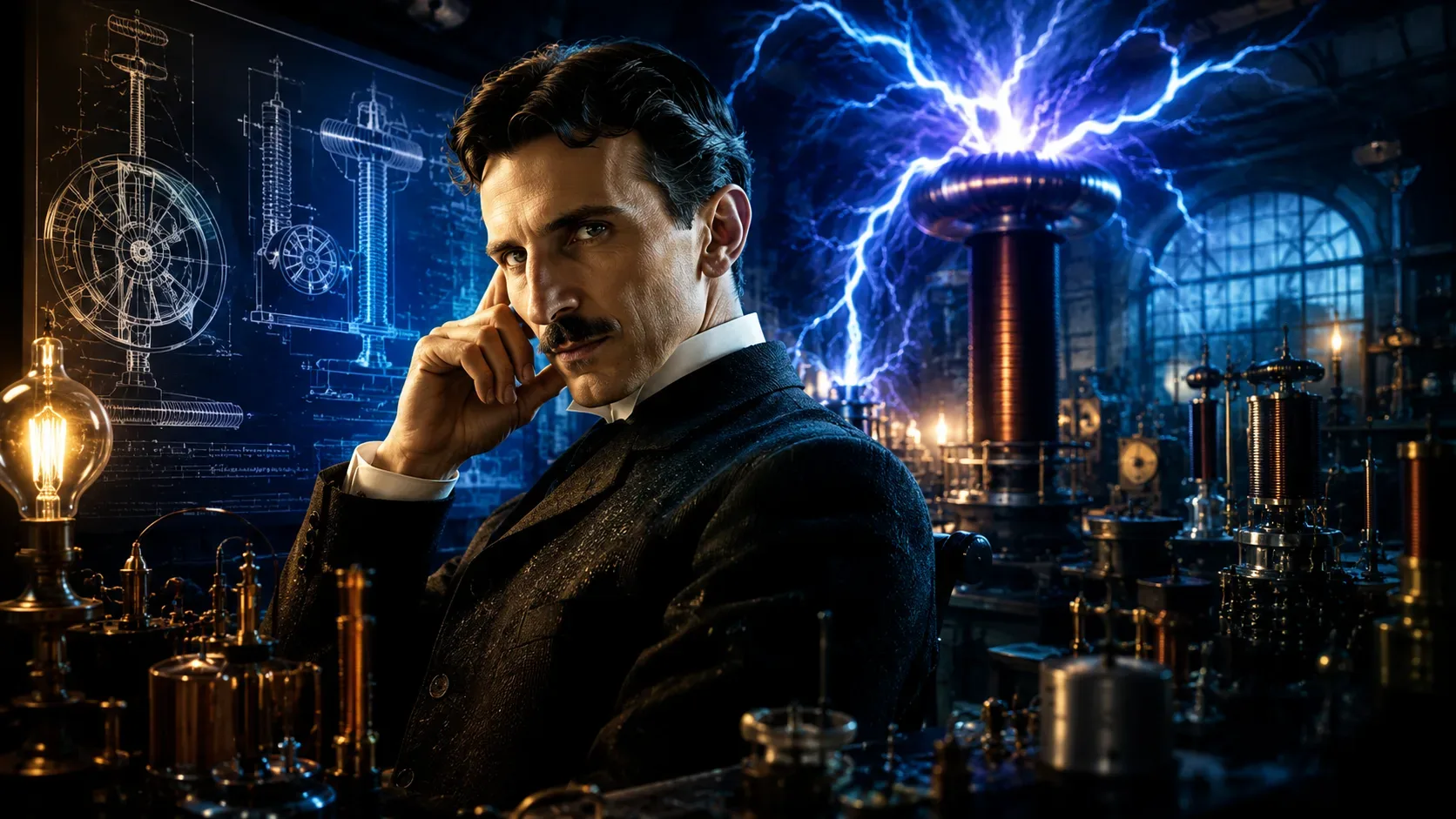
The young inventor who dreamed of mastering energy
Nikola Tesla was born in 1856 in the village of Smiljan, then part of the Austrian Empire (present-day Croatia). From an early age he demonstrated an impressive capacity for mental visualization, being able to imagine complete machines before even building prototypes.
After his engineering studies, Tesla worked in Europe and, in 1884, moved to the United States, where he would begin one of the most important phases of his career.
During this period, he worked briefly with Thomas Edison, one of the biggest names in the electrical industry at the time. The relationship between the two became historically known for the dispute involving two different models of energy distribution: direct current and alternating current.
The War of Currents: the dispute that defined the modern world
At the end of the 19th century, one of the greatest technological clashes in history took place, known as War of the Currents.
On one side was Thomas Edison defending direct current (DC), a system that required plants close to consumption sites due to the difficulty of transmitting over long distances.
On the other side was Tesla, supported by businessman George Westinghouse, defending alternating current (AC).
The great advantage of alternating current was the possibility of increasing or reducing its voltage using transformers, allowing electricity to be transported over long distances with less energy loss.
This technology has become the global standard for electrical distribution and continues to be used in virtually all modern power supply systems.
The alternating current system: the invention that lit up the planet
Tesla's most revolutionary contribution was the development of the polyphase alternating current system.
His patents included:
- alternating current induction motors;
- electric generation and transmission systems;
- transformers and electrical control mechanisms.
The definitive demonstration of the success of this technology came when Westinghouse's company won the contract to light the Chicago World's Fair of 1893.
Shortly thereafter, the harnessing of energy from Niagara Falls using alternating current systems became a historic milestone, proving that it was possible to transmit electricity on a large scale to cities and industries.
The Tesla Coil and high frequency experiments
Among the best-known creations is the Tesla Coil, developed in 1891.
The equipment allowed the production of electricity at high frequencies and voltages, creating impressive electrical discharges.
Although often associated with visual demonstrations using artificial lightning, her studies contributed to research on radio, wireless transmission and the behavior of electromagnetic waves.
To this day, the coil is used in scientific demonstrations and studies related to electricity.
Tesla and wireless communication: a vision before its time
Tesla believed that one day it would be possible to transmit information wirelessly across the planet.
At the beginning of the 20th century, the ambitious project of the Wardenclyffe Tower, built in New York, began with the aim of developing advanced wireless transmission systems.
The project was not completed due to a lack of financial resources, but it demonstrated Tesla's vision of a globally connected future.
Some of his predictions about mobile communication and instantaneous transmission of information are reminiscent of aspects of the internet and modern smartphones, although many of his ideas were not technically realized in the way he imagined.
The myth and reality about Tesla's inventions
Over the years, Nikola Tesla became a figure surrounded by several myths.
It is common to find claims that he single-handedly invented virtually all modern technology, including radio, the Internet, or unlimited free energy.
Historical reality is more complex.
Tesla was an extraordinary inventor and pioneer in many areas, but technological advancement typically occurs through the work of many scientists, engineers, and companies over decades.
Recognizing your true contribution makes your legacy even more impressive.
Why does Nikola Tesla remain relevant in the 21st century?
More than a hundred years after the peak of his career, Tesla's ideas remain present in many aspects of modern life.
Your work influences:
- energy distribution networks;
- industrial electric motors;
- modern electric vehicles;
- communication systems;
- research in electricity and magnetism.
In addition to his scientific importance, Tesla represents the archetype of the visionary inventor: someone capable of imagining possibilities long before society possesses the resources necessary to make them a reality.
Conclusion
Nikola Tesla was not only a brilliant inventor, but one of the main people responsible for shaping the technological infrastructure that sustains the contemporary world.
His advocacy of alternating current transformed the distribution of energy, his research expanded knowledge about electricity, and his ideas about wireless communication anticipated concepts that are now part of human routine.
His story is also a reminder that great technological advances are often born from the courage to challenge established models and imagine a future that does not yet exist.