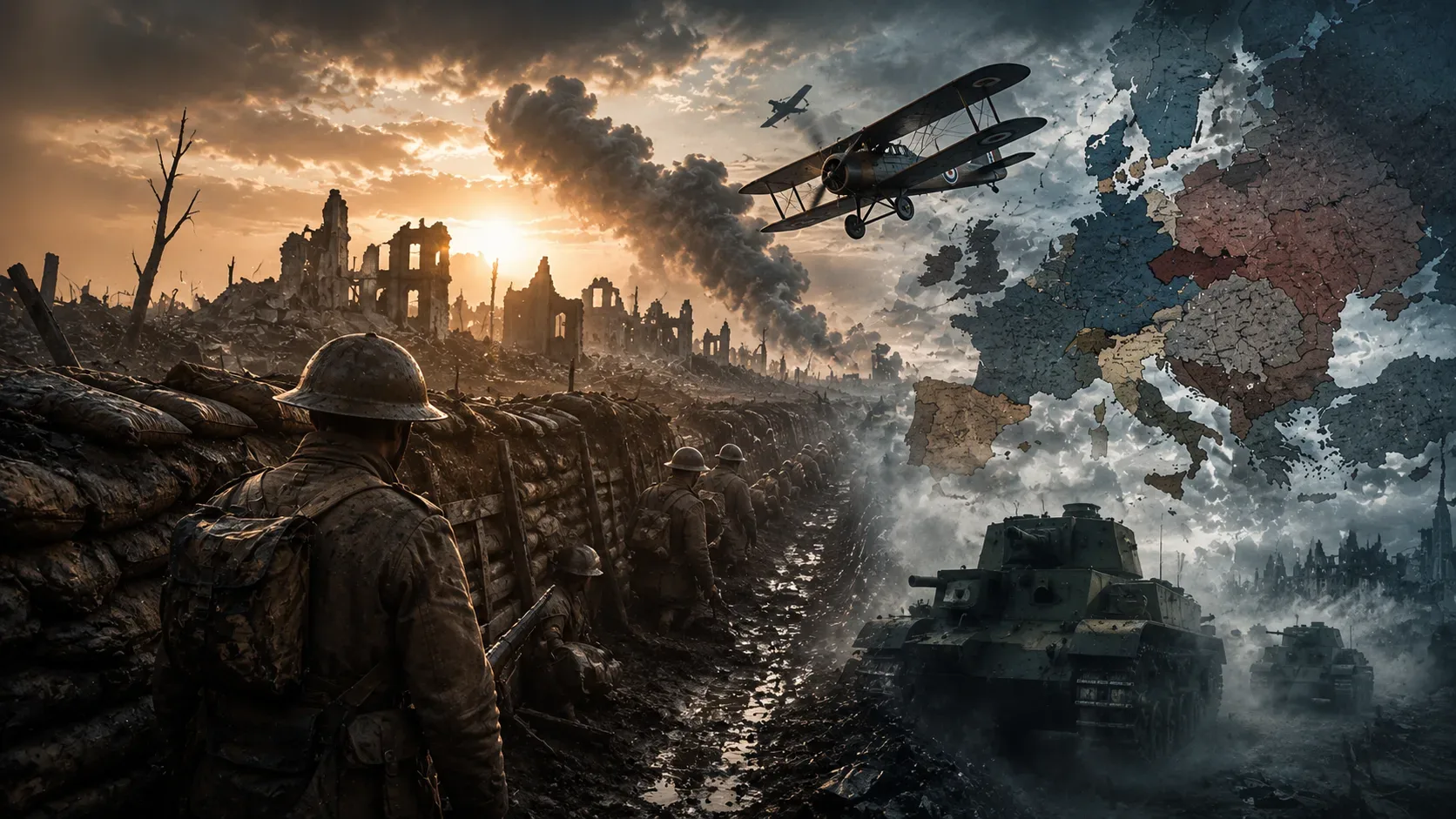
The world before 1914: a Europe divided by rivalries
At the beginning of the 20th century, Europe was the political and economic center of the planet, but behind the apparent stability there was a complex network of disputes between great powers.
Four main factors increased international tensions:
Nationalism
Different people advocated the creation of their own states or sought to expand the influence of their nations. In the Balkans, for example, nationalist movements contributed to a region marked by constant diplomatic crises.
Imperialism
The great European powers competed to conquer territories in Africa and Asia, competing for natural resources, consumer markets and political influence.
Militarism
The arms race led countries like the United Kingdom and Germany to invest heavily in armies, navies and new military technologies.
Alliance system
Europe was divided into two large blocks:
- Triple Entente: United Kingdom, France and Russia;
- Triple Alliance: Germany, Austria-Hungary, and Italy (although Italy later switched sides during the conflict).
This structure meant that a localized crisis could escalate into a continental war.
The trigger: the assassination that triggered a world war
On June 28, 1914, Archduke Franz Ferdinand, heir to the Austro-Hungarian Empire, was assassinated in Sarajevo by Gavrilo Princip, a Serbian nationalist linked to the Young Bosnia group.
The attack triggered a diplomatic crisis that became known as the July Crisis. Austria-Hungary declared war on Serbia, and the alliance system meant that several nations quickly entered the conflict.
What many leaders imagined would be a short war turned into four years of devastating battles.
A new form of warfare: technology and destruction on an industrial scale
The First World War marked the transition to modern warfare.
For the first time, industry was used on a large scale to produce weapons and equipment capable of causing unprecedented destruction.
Among the main innovations were:
- high-capacity machine guns;
- long-range heavy artillery;
- war tanks;
- planes used for reconnaissance and combat;
- submarines;
- chemical weapons, such as toxic gases.
The result was a war of attrition, especially in the trenches of the Western Front, where soldiers remained for months or years in extreme conditions.
The conflict is estimated to have caused approximately 20 million deaths, including military and civilian deaths, as well as tens of millions of injuries.
The end of war and the collapse of great empires
In 1918, following the entry of the United States into the conflict in 1917 and the weakening of the Central Powers, Germany signed the armistice on November 11, 1918.
The war caused the disappearance of four great empires:
- German Empire;
- Austro-Hungarian Empire;
- Russian Empire;
- Ottoman Empire.
New countries appeared on the European map, and old political structures were destroyed.
In the case of Russia, the difficulties caused by the war directly contributed to the Russian Revolution of 1917, which would later lead to the formation of the Soviet Union.
The Treaty of Versailles and the seeds of World War II
In 1919, the victorious powers established the Treaty of Versailles, considered one of the most important events for understanding subsequent conflicts.
The agreement imposed on Germany:
- loss of territories;
- severe reduction in military forces;
- payment of major financial reparations;
- acceptance of responsibility for the war through the so-called "guilt clause".
The victors' objectives were to prevent further German aggression and compensate for the damage caused by the conflict.
However, several historians argue that the conditions imposed fueled a strong feeling of humiliation, economic crisis and desire for revenge within German society.
This environment was later exploited by the Nazi Party, led by Adolf Hitler, during its rise to power in the 1930s.
Despite this, scholars also highlight that the Treaty of Versailles was not the only cause of the Second World War. The Great Depression of 1929, the fragility of the Weimar Republic, the growth of totalitarian regimes and international diplomatic failures also played a decisive role.
The social changes that transformed the 20th century
The First World War didn't just change borders.
She profoundly changed society.
The changing role of women
With millions of men sent to the front, many women began to work in industries, transport and essential services, expanding their participation in economic life and strengthening movements for the achievement of political rights.
The advancement of medicine
The need to treat millions of injured people has driven advances in surgery, orthopedics, blood transfusion and the organization of medical services.
The growth of State intervention
Governments began to control the economy more intensely during the war period, an experience that would influence economic and social policies in the following decades.
The creation of international organizations and the attempt to avoid new conflicts
The trauma caused by the war also generated efforts to create mechanisms for international cooperation.
The main initiative was the League of Nations, created in 1920 with the aim of resolving disputes between countries through diplomacy.
Despite representing an important advance in the idea of collective security, the League did not have sufficient mechanisms to prevent the military expansion of aggressive regimes in the following decades.
After World War II, his experiences would serve as one of the bases for the creation of the United Nations.
Why does the First World War still influence the world today?
The consequences of the war are still present today.
The conflict:
- redrawn the political map of the Middle East and Europe;
- contributed to the emergence of new ideologies and political regimes;
- transformed the way wars are fought;
- changed relations between governments, economy and society;
- paved the way for World War II.
Many historians consider the period between 1914 and 1945 as a long international crisis, in which the First and Second World Wars can be seen as two major chapters of the same era of global instability.
Conclusion
The First World War was much more than a conflict between armies. It represented the end of a world order based on great empires and the birth of a century marked by revolutions, ideological disputes and wars of even greater proportions.
The Treaty of Versailles, economic crises, the growth of extremist movements and the social transformations left by the conflict created a complex scenario that helped make World War II possible.
More than a century later, studying the First World War remains essential because its lessons demonstrate how political rivalries, extreme nationalism, economic crises and poorly managed diplomatic decisions can generate consequences that span generations.