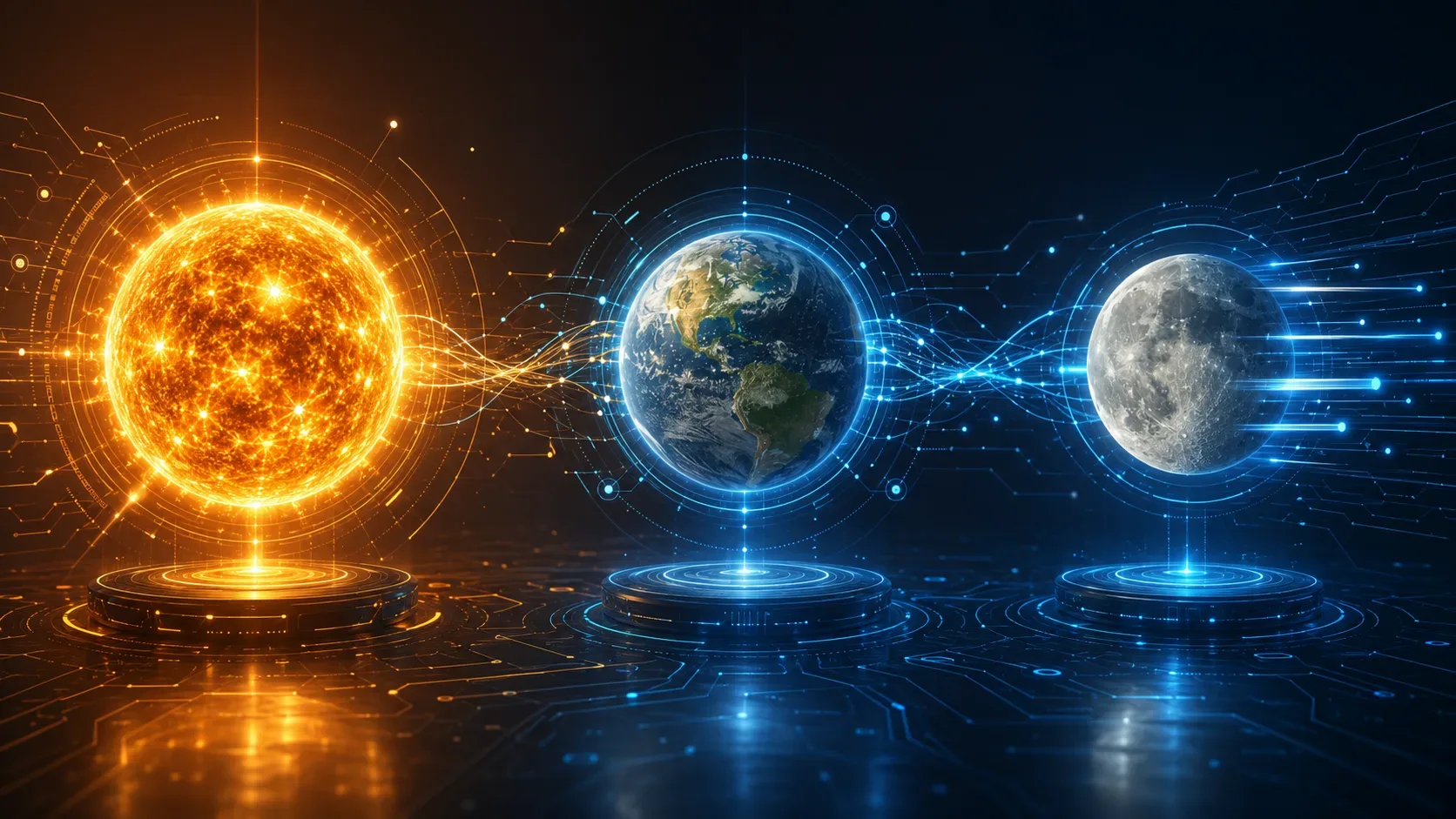
The GPT-5.6 family ushers in a simpler organization for OpenAI's advanced models. Instead of presenting only numbered versions, the company started to divide the generation into three permanent levels of capacity: Sun, Earth and Luna.
Although some people informally translate Luna as “Moon,” the official name of the model is GPT-5.6 Luna. The numbering identifies the generation, while the names represent different levels of capacity, speed and cost that may evolve at their own pace.
The choice, therefore, is not just about finding out which model is smarter. GPT-5.6 Sol offers the highest capacity; Terra seeks the best balance between quality and cost; and Luna prioritizes speed, economy and large-scale processing. Availability also changes depending on the plan and product used.
What are GPT-5.6 Sun, Earth and Luna?
Sol, Earth and Luna are part of the same technological generation, but were scaled for different needs.
OpenAI presents the GPT-5.6 Sol as its flagship model, the Terra as a lower-cost alternative with competitive performance, and the Luna as the fastest and most economical model in the family. All three were developed to work with programming, tool use, professional tasks, research, science, cybersecurity and automated flows.
In the API, the three models share important characteristics:
- Text and image input.
- Text output.
- Context window of approximately 1.05 million tokens.
- Up to 128 thousand output tokens.
- Configurable reasoning support.
- Web and file search.
- Use of tools and functions.
- Computer use.
- Image generation using integrated tools.
- Code interpreter and automated task execution.
The main difference is not in the tools available, but in the depth with which each model can reason, the execution cost and the appropriate speed for each type of flow.
GPT-5.6 Sun: the most powerful of the family
The GPT-5.6 Sol is the generation frontier model. It was developed for complex professional work that requires deep reasoning, interpretation of a lot of information, planning and coordinated use of tools.
According to OpenAI, Sol is designed specifically for programming, research, science, cybersecurity, computer use, design, and knowledge-based professional work. The GPT-5.6 Sol Pro version dedicates even more processing to difficult tasks and long workflows.
When the Sun is the best choice
The Sun tends to be more suitable for:
- Analyze extensive documents and relate scattered information.
- Plan systems, databases and software architectures.
- Investigate complex errors in applications.
- Create or review code involving multiple files.
- Produce in-depth research with source verification.
- Prepare spreadsheets, presentations and professional documents.
- Solve complex mathematical, financial or scientific problems.
- Run flows that depend on multiple tools.
- Work with decisions in which an error can generate significant rework.
OpenAI also highlights advances in creating documents, spreadsheets, financial models, presentations, interfaces and complete applications. The model seeks to follow reference formats with greater fidelity and improve elements such as hierarchy, spacing and visual organization.
Practical limitations of the Sun
Increased capacity comes at a cost. In API, the Sol is the most expensive model in the family. It can also consume more time and processing when configured with high levels of reasoning.
Therefore, using it for simple tasks, such as classifying sentences, generating short descriptions or standardizing thousands of records, may be unnecessary. In these cases, Terra or Luna can deliver sufficient results at a lower cost.
GPT-5.6 Terra: the best balance between quality and cost
The GPT-5.6 Terra occupies the middle position. OpenAI defines it as a model that balances intelligence and cost, roughly equivalent to the “mini” level used in previous generations.
This does not mean it is a basic model. In evaluations released by OpenAI, Terra presented results close to the Sun in some professional tasks, although the main model continues to be more consistent in more difficult problems. The company also claims that Terra offers competitive performance over GPT-5.5 at half the price.
When Terra is the best choice
Terra tends to work well in:
- Production and review of articles.
- Document summaries.
- Extracting data from files.
- Code generation with well-defined requirements.
- Creation of APIs, SQL queries and administrative routines.
- Automated service that requires elaborate responses.
- Analysis of spreadsheets and reports.
- Request classification.
- Agents who need to use tools without consuming Sol's budget.
- Frequent processing of tasks of medium difficulty.
For enterprises and developers, Terra will likely be the most interesting model in many production systems. It preserves good reasoning capacity, accepts large contexts and uses the same main tools, but costs half as much as Sol in the API.
Where the Earth can lose to the Sun
In very open, ambiguous or extensive tasks, Terra may need more detailed instructions. It may also present a greater need for review in complex research, strategic decisions, long-horizon programming or documents in which many requirements need to be met simultaneously.
An efficient strategy is to use Earth as a standard and forward only the most difficult cases to the Sun.
GPT-5.6 Luna: speed and savings for high volumes
The GPT-5.6 Luna is the fastest and cheapest model in the family. OpenAI reports that it is designed for cost-sensitive tasks and high-volume flows, roughly matching the “nano” level of previous generations.
The word “economic” should not be confused with disability. Luna continues to offer reasoning, insight, extensive context, and tool integration. The difference is that your priority is to perform many operations with lower cost and lower latency.
When Luna is the best choice
In practice, Luna may be suitable for:
- Classify large amounts of texts.
- Extract well-defined fields from documents.
- Generate titles, tags and short descriptions.
- Identify intent in messages.
- Standardize names and information.
- Answer simple FAQs.
- Produce content variations.
- Moderate or forward requests.
- Perform repetitive tasks on systems.
- Answer flows in which thousands of calls are made daily.
It can also function as the first stage of a system. Luna analyzes the request and decides whether it can resolve it or whether it should forward it to Terra or Sol.
Where Luna requires more care
Luna should not be chosen just because it costs less. In jobs that require sophisticated judgment, in-depth research, or interpretation of lengthy instructions, initial savings may disappear if answers need to be redone.
To obtain good results, tasks assigned to Luna must be objective, repeatable and accompanied by clear rules.
What is the best GPT-5.6?
There is no single winner for all situations. Each model is the best according to different criteria.
The following table summarizes the most appropriate choice.
| Criterion | Best model | Reason |
|---|---|---|
| Higher overall quality | GPT-5.6 Sol | Has the greatest reasoning ability in the family |
| Complex professional tasks | GPT-5.6 Sol | Handles ambiguity, planning, and long flows better |
| Best value for money | GPT-5.6 Earth | Balances intelligence, speed and price |
| Frequent use in systems | GPT-5.6 Earth | Reduces costs without losing much capacity |
| Greater speed and scale | GPT-5.6 Luna | Is optimized for high-volume tasks |
| Lower cost per call | GPT-5.6 Luna | Has the lowest entry and exit prices |
| Advanced search and programming | GPT-5.6 Sol | It is the recommended model for complex reasoning and code |
| Simple extractions and classifications | GPT-5.6 Luna | Solve well-defined tasks economically |
The best model in capacity is the Sun. The best balance for most systems is the Earth. The best for quick, simple and numerous tasks is Luna.
How much do Sol, Terra and Luna cost in the API?
The prices below apply to the OpenAI API and do not represent an additional per-message charge within a regular ChatGPT subscription.
| Template | Entry for 1 million tokens | Exit for 1 million tokens |
| GPT-5.6 Sol | US$ 5.00 | US$ 30.00 |
| GPT-5.6 Earth | US$ 2.50 | US$ 15.00 |
| GPT-5.6 Luna | US$ 1.00 | US$ 6.00 |
All three also offer a 90% discount for reading cached entries. Requests with more than 272,000 input tokens receive higher pricing for the entire request.
These values show the logic of the family: Terra costs half as much as Sol, while Luna costs a fifth as much as Sol on entry and exit.
Which GPT-5.6 models are released in Brazil?
Until July 19, 2026, Brazil does not have an exclusive regional restriction for the GPT-5.6 family. OpenAI informs that access follows the general list of countries and territories compatible with ChatGPT and the API. However, regional availability does not mean that all models are available for all plans.
Common ChatGPT conversations
In standard conversations, the situation is as follows:
| Plan | GPT-5.6 available in regular chat |
| Free | None |
| Go | None |
| Plus | GPT-5.6 Sun at Medium and High levels |
| Pro | GPT-5.6 Sun at Medium, High, Extra High and Pro levels |
| Business | GPT-5.6 Sun at Medium, High, Extra High and Pro levels |
| Enterprise | GPT-5.6 Sun at Medium, High, Extra High and Pro levels |
GPT-5.5 Snapshot remains the default model for quick queries. When the user chooses Medium, High or Extra High on a supported plan, ChatGPT uses GPT-5.6 Sol. The Pro option uses GPT-5.6 Sol Pro.
Terra and Luna cannot be selected directly in a standard ChatGPT conversation, regardless of whether the user is in Brazil or another supported country.
ChatGPT Work, Codex and API
In other areas of OpenAI products, the distribution is different:
| Product | Availability |
| ChatGPT Work | Sun, Earth and Luna for Plus, Pro, Business and Enterprise |
| Codex | Land for Free and Go; Sol, Terra and Luna for Plus, Pro, Business and Enterprise |
| OpenAI API | Sun, Earth and Luna for developers with access to the platform |
OpenAI also informs that the release may occur gradually. Therefore, even an account that has an eligible plan may not immediately see all options. In enterprise workspaces, the administrator can also limit access to templates.
Is any model available to all Brazilian users?
Not in regular ChatGPT conversations.
Free and Go users do not have access to GPT-5.6 Sol in the standard chat, while Terra and Luna do not appear as selectable options in this type of conversation. Terra can be used on Codex through the Free and Go plans, but this does not equate to a general release in conventional chat.
Therefore, the most correct formulation is: the GPT-5.6 family is available in Brazil, but access depends on the plan, the product and the gradual release for each account.
How to choose the reasoning level of GPT-5.6 Sol
In ChatGPT, the Sun appears through levels of reasoning:
- Medium: suitable for common complex tasks, analysis, programming and documents.
- High: devotes more processing to difficult problems.
- Extra high: offers the greatest effort of regular reasoning.
- Pro: uses the GPT-5.6 Sol Pro for especially difficult and prolonged work.
Always using the maximum level does not automatically guarantee the best result. For well-defined requests, the Medium level may be sufficient and faster. High or Extra High make more sense when the model needs to compare many possibilities, find difficult errors, or respect a large set of requirements.
How to get the best out of GPT-5.6 Sol
Sol works best when given context, controlled freedom to analyze the problem, and clear quality criteria.
A good prompt for the Sun should say:
- What is the ultimate goal.
- What context needs to be considered.
- Which files or data are priority sources.
- What restrictions must be respected.
- What format needs to be delivered.
- How the answer should be checked.
- What to do when there is insufficient information.
Example prompt:
“Analyze the attached files and identify inconsistencies between the requirements, the database and the code. First present the problems found in order of impact. Then propose a solution, explain the risks and deliver the necessary changes. Do not invent missing fields and flag any information that needs confirmation.”
For research, ask the model to differentiate confirmed facts, interpretations, and projections. For programming, provide the project structure, technologies used, error messages, and expected behavior.
Sol also benefits from staged reviews. After the first delivery, ask for a specific audit, such as: “Now review only security, performance and compatibility, without changing already approved features.”
How to get the best out of GPT-5.6 Terra
Terra responds best when work is organized and exit criteria are objective.
To increase quality:
- Divide large flows into steps.
- Provide an example of input and output.
- Indicate which fields are mandatory.
- Define rules for missing data.
- Specify the final format.
- Avoid accumulating too many unrelated tasks in the same prompt.
- Ask for a final check before delivery.
Example prompt:
“Extract the number, budget unit, supplier, items, quantities and values from each document. List the records by budget unit and instrument number. When there is a discrepancy, do not choose silently: mark the field as ‘revision required’ and explain the conflict.”
Terra is especially efficient when there is a stable process. Once the prompt is validated, it can be reused in similar tasks with a good balance between quality and cost.
How to get the best out of GPT-5.6 Luna
With Luna, the main rule is to turn broad requests into small, verifiable tasks.
Suitable prompts should have:
- A main function.
- Few rules, but precise rules.
- Hard output format.
- Short examples.
- Clear criteria for exceptions.
- Texts and data already prepared for processing.
Example prompt:
“Classify each message into one of these categories: financial, technical support, commercial or others. Respond only in JSON with the fields ‘category’, ‘confidence’ and ‘short_justification’. When confidence is less than 0.70, use the ‘human_review’ category.”
Luna can run large volumes, but critical tasks must undergo validation. A good architecture is to use it to triage and forward ambiguous cases to Earth or Sun.
The best strategy can combine the three models
Businesses and developers don't need to choose a single model for their entire system. A waterfall architecture can leverage the strengths of each:
- Luna receives, classifies and organizes the request.
- Earth solves cases of medium difficulty.
- Sun only assumes complex, sensitive or ambiguous problems.
- An automatic rule or confidence assessment decides when the case should move up a level.
- Critical results undergo human review.
This combination reduces costs without forcing all requests to rely on the most expensive model. OpenAI recommends Sol for complex reasoning and programming, Terra for balancing capacity and cost, and Luna for large, price-sensitive workloads.
Good practices that work in all three models
Regardless of the model chosen, clear prompts remain key. OpenAI itself recommends providing sufficient context, avoiding ambiguity, indicating expected tone, and iteratively refining instructions after evaluating the first response.
A simple and reusable structure is:
Context: explain the situation and present the data.
Purpose: state exactly the expected result.
Rules: enter limits, prohibitions and mandatory criteria.
Format: determine how the response should be organized.
Verification: ask to check facts, calculations, fields or requirements before delivery.
Uncertainty handling: explain how the model should act when it does not find information.
It is also important to remember that none of the three models completely eliminate errors or invented information. Current data, legal decisions, medical information, financial calculations and changes to production systems must be verified before final use.
Conclusion: Sun, Earth or Luna?
The GPT-5.6 Sol is the best choice when the priority is maximum capacity, deep thinking and executing complex jobs. Terra tends to be the most balanced option for companies, automations and frequent professional tasks. Luna excels in fast, standardized and large-scale operations.
In Brazil, the GPT-5.6 family can now be used in compatible products, but none of the three models is available to all users in common ChatGPT conversations. Sol is restricted to eligible paid plans, while Terra and Luna appear mainly in ChatGPT Trabalho, Codex and API.
The best choice does not just depend on which model achieves the highest score. It depends on the value of each response, the difficulty of the work, the volume of requests and the acceptable cost. In many projects, the most efficient result will come from combining the three levels.