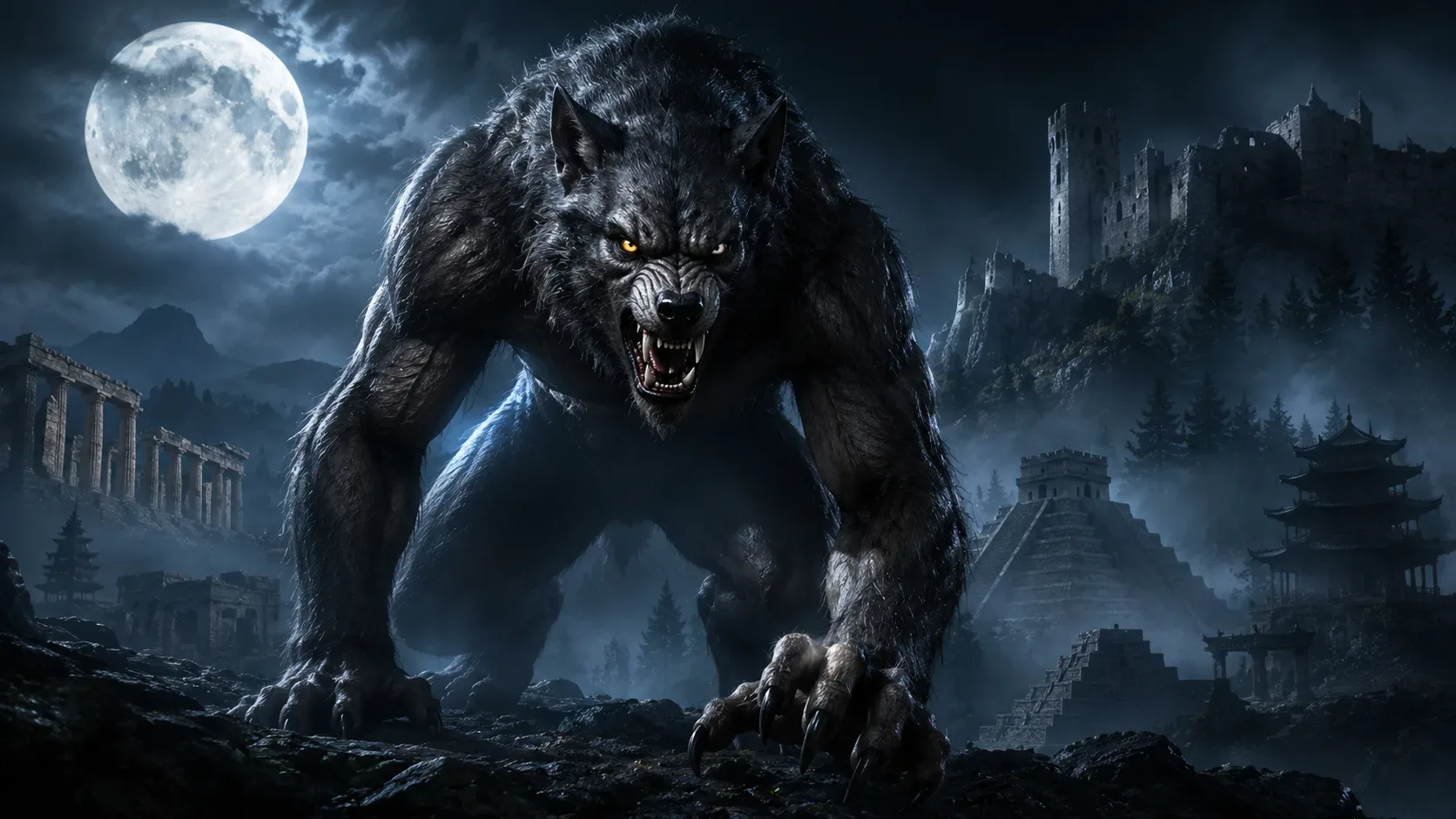
The earliest origins of the werewolf legend
The idea of a human being transforming into an animal is much older than the word "werewolf" itself. Ancient civilizations already had stories about metamorphosis, generally associated with curses, divine punishments or supernatural powers.
One of the oldest accounts related to the werewolf comes from Ancient Greece, in the story of the king Lycaon, narrated by authors such as Ovid in Metamorphoses. According to myth, Lycaon tried to trick the god Zeus by offering human flesh during a banquet. As punishment, Zeus transformed him into a wolf-like creature.
In fact, the word lycanthropy originates from the Greek lykos (wolf) and anthropos (man), literally meaning "wolf-man".
This story established one of the main characteristics present in later legends: transformation as a consequence of a curse or a break in human rules.
The werewolf in Medieval Europe
It was during the Middle Ages that the figure of the werewolf was consolidated in the European imagination.
Between the 15th and 17th centuries, several regions of France, Germany and other European countries registered legal proceedings against people accused of being werewolves. As with witchcraft trials, many of these cases were linked to religious beliefs, fear of the unknown, and supernatural interpretations of unexplained crimes or events.
One of the most famous cases was that of Gilles Garnier, in 16th century France. He confessed, under interrogation, to having received a magical ointment that allowed him to transform into a wolf and was sentenced to death in 1573.
Another famous case is that of Peter Stumpp, in Germany, accused in 1589 of carrying out murders while transformed into a wolf. Modern historians consider these reports to be part of a context of collective hysteria, religious persecution and extremely violent justice systems at the time.
It is important to highlight that there is no scientific evidence that humans can physically transform into wolves. These episodes are studied as historical, social and cultural phenomena.
The link between the werewolf and the full moon
Today it is almost impossible to imagine a werewolf without associating it with the full moon. Interestingly, this element was not universal in ancient legends.
The strong connection between transformation and the moon became popular mainly through 19th and 20th century literature and cinema, especially after the success of Hollywood horror films.
The moon, in different cultures, has always been associated with mystery, night, madness and changes in nature, becoming a perfect symbol for the transformation of man into a beast.
Werewolves in different countries and cultures
The idea of human creatures taking on animal form appears in several places around the world.
Brazil - The Werewolf of popular folklore
In Brazilian folklore, the legend arrived through Portuguese influence and gained its own characteristics.
One of the best-known versions states that the werewolf would be the seventh male child of a family that only has children of the same sex. The transformation would happen on certain nights, generally from Thursday to Friday, when the man would run along roads, forests and cemeteries.
In many rural regions, reports of howls, unknown animals, and nocturnal apparitions have helped keep the legend alive for generations.
Portugal - The Werewolf
In Portugal, there are similar stories known as "werewolves". Some traditions held that the curse could arise through sins, family curses, or specific rituals.
The narratives vary greatly between different Portuguese regions, but generally involve an individual condemned to live between their humanity and their animal nature.
Scandinavia - Berserkers and wolf warriors
In Norse mythology there were the berserkers and the úlfhéðnar, warriors who used animal skins and were believed to enter states of fury similar to the power of bears and wolves.
Although they were not werewolves in the modern sense, they represent the ancient idea of the spiritual fusion between man and animal.
Japan - Kitsune and animal transformations
Japanese folklore does not have an exact equivalent to the werewolf, but presents several creatures capable of changing shape.
One of the most famous examples is the Kitsune, a spiritual fox that can take on a human appearance, deceive people or act as a protector depending on the story.
This concept shows that the transformation between human and animal is a universal theme in the human imagination.
North America - Skinwalkers and other creatures
In some North American indigenous traditions, especially those associated with the Navajo people, there are reports of skinwalkers, figures linked to transformation rituals and supernatural powers.
As it is a specific and sensitive cultural belief, many traditional details are not shared openly by the indigenous people themselves. The association with "werewolves" is a comparison made by outside observers, not a perfect equivalent.
Lycanthropy in medicine and psychology
Beyond the legend, there is the medical concept called clinical lycanthropy, an extremely rare psychiatric condition in which a person believes they have transformed or are transforming into an animal.
This condition has been recorded in psychiatric studies throughout history and is usually associated with other mental disorders.
It has no relation to the real existence of werewolves, but it demonstrates how the idea of human-animal transformation also appears in human experience and medicine.
The werewolf in literature and cinema
The werewolf has become one of the greatest icons of popular culture.
Some important works include:
- The Wolfman (1941), a film that helped establish the modern image of the creature;
- An American Werewolf in London (1981), famous for its special transformation effects;
- Van Helsing (2004), which featured a more monstrous version of the creature;
- The Girl in the Red Cloak (2011), a dark retelling of the classic tale;
- series like Teen Wolf, which reinterpreted the myth for new generations.
Each era adapted the werewolf to its own fears: in the Middle Ages, the fear of evil and nature; in the modern era, the fear of loss of control and the wild side of human beings.
Why does the legend of the werewolf survive to this day?
The werewolf remains popular because it symbolizes one of humanity's greatest conflicts: the struggle between reason and instinct.
The creature represents the fear of losing control, of revealing our more aggressive side, or of being transformed into something we don't recognize.
Furthermore, the combination of mystery, terror, nature and personal tragedy makes the werewolf one of the richest figures in world folklore.
Conclusion
The legend of the werewolf was born from ancient stories about transformation and has been reinvented across thousands of years by different cultures.
From King Lycaon in Ancient Greece to the trials of alleged werewolves in Europe, from Brazilian rural roads to Hollywood films, the werewolf has changed shape several times — just like the legend itself.
Even without any evidence of its real existence, the werewolf remains alive in the human imagination because it represents universal fears: the unknown, the night, wild nature and the darkest part that exists within each person.